

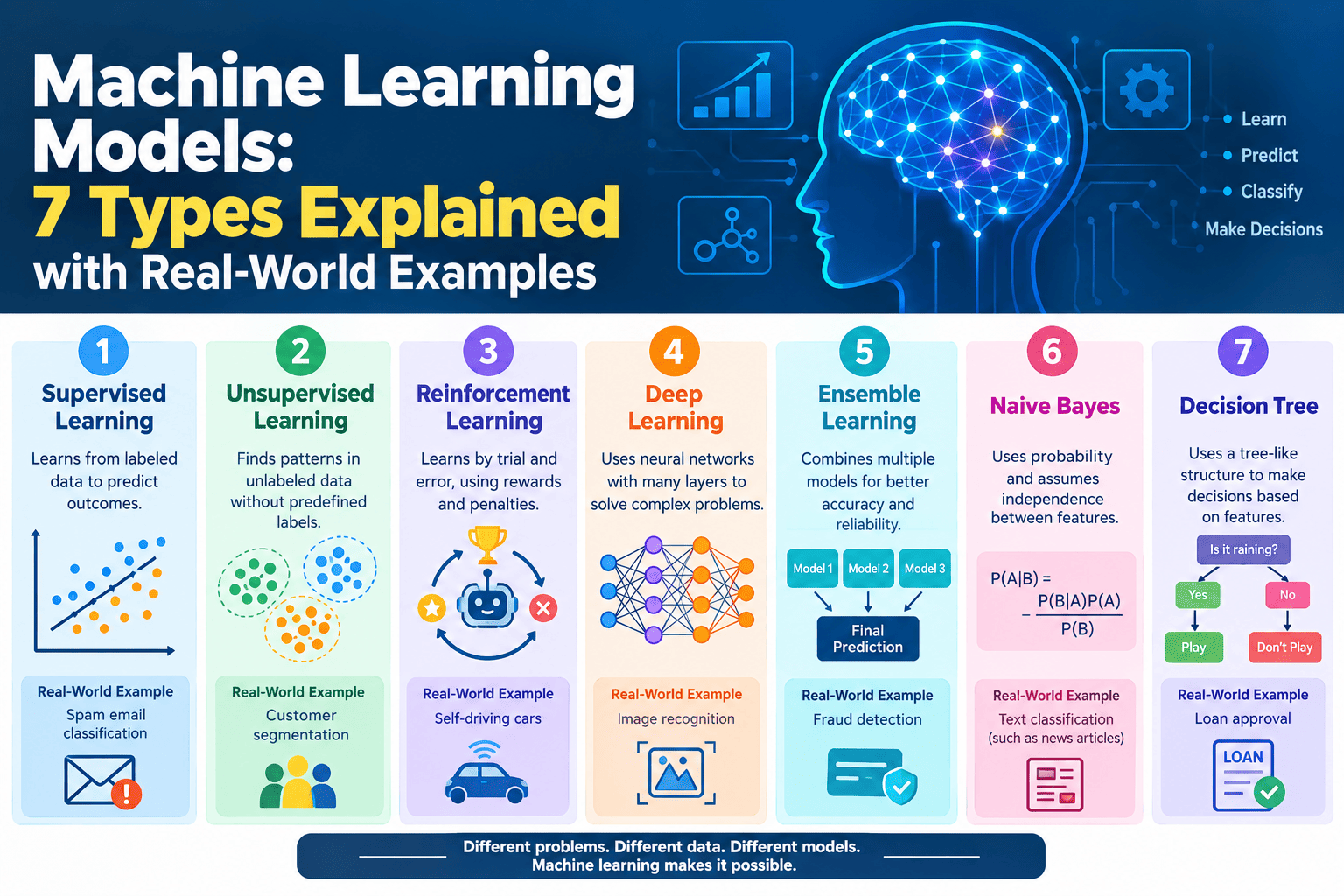
Machine learning models are mathematical systems trained on data to recognize patterns, make predictions, classify information, or generate new content. Common examples include linear regression, decision trees, random forests, support vector machines, k-nearest neighbors, clustering models, and neural networks. Each model has different strengths, making the right choice dependent on the problem, available data, accuracy requirements, and computing resources.
Introduction
Machine learning is transforming how businesses analyze information, automate repetitive tasks, and make data-driven decisions. From email spam filters and product recommendations to fraud detection and image recognition, machine learning models help computers identify patterns that would be difficult or time-consuming to discover manually.
However, not every model solves the same problem. Some predict numerical values, others categorize information, and some discover hidden relationships in large datasets. Understanding these differences is essential for students, developers, business owners, and anyone beginning a career in artificial intelligence.
In this guide, we explore seven important machine learning model types, explain how they work in simple language, and provide practical examples to help you understand when each approach is useful.
What Are Machine Learning Models?
A machine learning model is a mathematical representation of patterns learned from training data. After training, the model uses those learned patterns to make predictions or produce outputs for new information.
For example, imagine a company wants to estimate the selling price of a house. It collects historical information about property prices, locations, sizes, bedrooms, and property conditions. A machine learning algorithm can learn relationships between these features and the final selling prices. Once trained, the resulting model can estimate prices for houses it has not previously encountered.
A model is different from an algorithm. An algorithm is the procedure used to learn patterns from data, while a model is the learned result of that process.
Machine learning models are commonly used for:
- Predicting prices, demand, sales, and future trends.
- Classifying emails, images, documents, and customer requests.
- Detecting suspicious transactions and unusual behavior.
- Grouping customers according to similar characteristics.
- Recommending products, movies, music, and other content.
- Understanding text, recognizing speech, and generating content.
The model’s usefulness depends on the quality of its training data, the suitability of its learning method, and how carefully it is evaluated.
The Main Types of Machine Learning
Before examining individual models, it is helpful to understand the three major learning approaches.
1. Supervised Learning
Supervised learning uses labeled training data, meaning that examples include the expected answers. The model learns relationships between input features and known outputs.
For example, a dataset containing house sizes and their actual selling prices can train a model to estimate the price of another house.
Supervised learning is commonly divided into two tasks:
- Regression: Predicting numerical values, such as temperature, revenue, or property prices.
- Classification: Predicting categories, such as spam versus legitimate email or fraudulent versus legitimate transactions.
2. Unsupervised Learning
Unsupervised learning works with data that does not have predefined target labels. Instead of learning from known answers, the model searches for patterns, similarities, clusters, or unusual observations.
For example, an online retailer might group customers according to their shopping behavior without knowing the customer segments in advance.
Clustering and dimensionality reduction are common unsupervised learning techniques.
3. Reinforcement Learning
Reinforcement learning trains an agent to make decisions through interaction with an environment. The agent receives rewards or penalties and learns a strategy that aims to maximize long-term rewards.
Examples include training game-playing systems, optimizing certain robotic behaviors, and managing decisions in simulated environments.
These three approaches describe how a system learns. The seven models below are specific techniques or model families, and they do not all belong to the same category.
7 Machine Learning Models Explained with Real-World Examples
1. Linear Regression
Linear regression is one of the most widely taught and commonly used machine learning models. It estimates the relationship between input variables and a numerical outcome.
The model attempts to fit a line, or a higher-dimensional linear relationship, through the available data. It then uses that relationship to predict values for new observations.
How it works
Suppose a business wants to predict monthly sales based on advertising expenditure. A linear regression model analyzes historical spending and sales figures to estimate how the variables are related.
A simplified equation is:
y = mx + b
Here, y represents the predicted outcome, x represents an input variable, m represents the slope, and b represents the intercept.
Real-world applications include:
- Estimating property prices.
- Forecasting sales and revenue.
- Analyzing business expenses.
- Studying relationships between measurable variables.
- Predicting demand when a reasonably linear relationship is appropriate.
Advantages: Linear regression is relatively easy to interpret, computationally efficient, and useful as a baseline for numerical prediction.
Limitations: Simple linear regression may perform poorly when relationships are strongly nonlinear or important variables are missing. Results can also be affected by outliers and violations of modeling assumptions.
Best for: Numerical prediction when a linear relationship is a reasonable approximation.
2. Logistic Regression
Despite its name, logistic regression is primarily used for classification rather than ordinary numerical regression. It estimates the probability that an observation belongs to a particular category.
For a binary classification problem, the model produces a probability between zero and one. A decision threshold can then turn that probability into a predicted class.
How it works
Consider an email service that needs to determine whether a message is spam. The model can analyze features such as message characteristics, sender information, and word patterns to estimate the probability of spam.
Other applications include:
- Predicting whether a customer may cancel a subscription.
- Estimating the likelihood of loan default.
- Classifying certain medical test outcomes.
- Predicting whether a user will click an advertisement.
Advantages: Logistic regression is often fast, provides probability estimates, and can offer interpretable relationships between input features and outcomes.
Limitations: It may struggle with complex nonlinear patterns unless suitable features or transformations are introduced. Its probability estimates also require careful evaluation and, in some cases, calibration.
Best for: Binary or multiclass classification tasks where interpretability and probability estimates matter.
3. Decision Trees
A decision tree makes predictions by splitting data into smaller groups according to feature-based rules. Its structure resembles a flowchart, with branches representing decisions and leaves representing predictions.
How it works
Imagine a bank wants to identify applications that may require additional review. A decision tree could examine income, existing debt, repayment history, and other relevant information.
A simplified tree might ask:
- Is the applicant’s income above a specified threshold?
- Does the applicant have a history of missed payments?
- Is the existing debt relatively high?
The answers guide the observation through the tree until it reaches a prediction.
Real-world applications include:
- Customer qualification and segmentation.
- Fraud detection.
- Predictive maintenance.
- Credit risk assessment.
- Medical decision-support research.
Advantages: Decision trees are relatively easy to visualize, handle nonlinear relationships, and can work with numerical and categorical features depending on the implementation.
Limitations: A single tree can overfit its training data and become unstable when the dataset changes. Pruning and depth restrictions can help control these problems.
Best for: Problems that benefit from understandable decision rules and straightforward interpretation.
4. Random Forest
Random forest is an ensemble learning method that combines predictions from multiple decision trees. For classification, the trees’ predictions can be combined through voting; for regression, their predictions are commonly averaged.
Rather than relying on one tree, random forests introduce variation into tree training and aggregate the results. This often improves generalization compared with an individual, unrestricted decision tree.
How it works
Suppose an online retailer wants to predict whether an order might be fraudulent. A random forest builds many trees using variations of the training data and selected features. Their combined predictions produce the final result.
Common applications include:
- Fraud detection.
- Customer churn prediction.
- Sales and demand forecasting.
- Risk assessment.
- Identifying important predictive features.
Advantages: Random forests can capture complex relationships, work well on many structured datasets, and generally reduce the variance associated with individual decision trees.
Limitations: They may require more memory and computing resources than a single tree. Their combined predictions are also harder to explain in detail than a small decision tree.
Best for: Structured data problems where strong predictive performance and robustness are priorities.
5. Support Vector Machines (SVM)
A support vector machine is a supervised learning method used for classification and, in some forms, regression. It attempts to find a decision boundary that separates categories while maximizing the margin between them.
With suitable kernel functions, an SVM can also model nonlinear decision boundaries.
How it works
Imagine a system that classifies documents into two categories. Each document is represented using numerical features. The SVM searches for a boundary that separates the categories as effectively as possible.
The observations closest to that boundary are called support vectors because they help determine its position.
Applications include:
- Text classification.
- Image classification.
- Certain biological data analyses.
- Pattern recognition.
- Classification tasks involving small or medium-sized datasets.
Advantages: SVMs can work well in high-dimensional feature spaces and can model complex boundaries with appropriate kernels.
Limitations: Selecting the right kernel and tuning parameters may require experimentation. Training can also become expensive for very large datasets, and the model may be less interpretable than simpler alternatives.
Best for: Classification problems with clear margins, especially when the dataset is not excessively large.
6. K-Nearest Neighbors (KNN)
K-nearest neighbors is a simple, instance-based learning method that predicts an observation’s outcome by examining nearby examples in the training dataset.
For classification, it commonly uses the most frequent class among the nearest neighbors. For regression, it often averages the neighbors’ numerical values.
How it works
Imagine a music recommendation application that represents songs using features such as tempo, energy, and musical characteristics. KNN can identify songs with similar feature values and use nearby examples to support a prediction or recommendation.
Potential applications include:
- Similarity-based recommendations.
- Pattern recognition.
- Image classification.
- Exploratory data analysis.
- Predicting values from nearby observations.
Advantages: KNN is intuitive, relatively easy to implement, and does not require fitting a complex parametric model during training.
Limitations: Predictions can become slow when the dataset is large. Results also depend on feature scaling, the choice of distance measure, and the number of neighbors selected. Irrelevant features can reduce accuracy.
Best for: Smaller datasets and problems where similarity between observations is meaningful.
7. Neural Networks
Neural networks are machine learning models made up of connected computational units arranged in layers. During training, the model adjusts its parameters to learn patterns that help it perform a particular task.
Deep learning refers to neural network approaches that use multiple layers to learn increasingly complex representations.
How it works
Consider a system designed to recognize objects in photographs. Early layers may learn basic visual patterns, while deeper layers can combine those patterns into more complex representations. The final layers use the learned information to predict the likely object category.
Neural networks are used for:
- Image and speech recognition.
- Language translation.
- Text classification.
- Recommendation systems.
- Forecasting complex patterns.
- Generative AI applications.
Advantages: Neural networks can learn highly complex relationships and work with large amounts of text, images, audio, and other data.
Limitations: They may require substantial training data, computing resources, and careful tuning. Their decisions can also be difficult to interpret, and they can reproduce biases present in their training data.
Best for: Complex problems involving large datasets, unstructured information, or patterns that simpler models struggle to capture.
Comparison Table: Which Machine Learning Model Should You Choose?
| Model | Main purpose | Example application | Key consideration |
| Linear regression | Numerical prediction | House price estimation | Assumes a linear relationship in its basic form |
| Logistic regression | Classification | Spam probability | Works well as an interpretable baseline |
| Decision tree | Classification or regression | Rule-based risk assessment | Can overfit without suitable constraints |
| Random forest | Classification or regression | Fraud detection | Combines multiple trees |
| Support vector machine | Classification or regression | Document classification | Requires careful parameter selection |
| K-nearest neighbors | Classification or regression | Similarity-based prediction | Sensitive to scaling and distance |
| Neural network | Complex prediction and representation learning | Image recognition | May require substantial data and computing |
There is no universally best machine learning model. The right choice depends on the data, target outcome, acceptable error, deployment environment, and the importance of interpretability.
How Do Machine Learning Models Work?
Although individual techniques differ, most machine learning projects follow a similar workflow.
Step 1: Define the Problem
Start by identifying the question the model must answer. Decide whether the task involves predicting a numerical value, assigning a category, discovering groups, or choosing actions.
A clear objective makes it easier to select an appropriate evaluation method.
Step 2: Collect Relevant Data
Gather data that represents the problem the model will encounter in practice. Depending on the task, the data may include customer transactions, sensor readings, images, text, or historical measurements.
Data should be collected responsibly, with suitable attention to privacy, consent, and applicable regulations.
Step 3: Clean and Prepare the Data
Check for missing values, duplicate records, inconsistent formats, incorrect labels, and unusual observations. Prepare features in a form the selected model can use.
Some models also benefit from numerical feature scaling, categorical encoding, or transformations.
Step 4: Split the Dataset
Divide the data into training and evaluation sets. A separate validation set can help compare models and tune their settings.
For time-series forecasting, use a time-aware split rather than randomly mixing future observations into the training data. This helps prevent information leakage.
Step 5: Train the Model
The learning algorithm uses the training data to estimate parameters or discover useful patterns.
Different models learn in different ways. Linear regression estimates coefficients, decision trees choose splits, and neural networks adjust weights through optimization.
Step 6: Evaluate Performance
Test the model on data that was not used to fit it. Select metrics that match the task.
For example, regression may use mean absolute error or root mean squared error. Classification may use precision, recall, F1 score, ROC-AUC, or accuracy, depending on the problem.
Accuracy alone can be misleading when one class is much more common than another.
Step 7: Deploy and Monitor
After testing, integrate the model into the intended application. Monitor its performance, data quality, prediction errors, and changing real-world conditions.
Models may need retraining or replacement when patterns change or performance declines.
Real-World Applications of Machine Learning Models
Machine learning models are used across industries, but their effectiveness depends on the task, data, and implementation.
Healthcare
Machine learning can assist with medical image analysis, research, risk prediction, and workflow prioritization. Clinical applications require appropriate validation, privacy protections, and professional oversight.
Banking and Finance
Financial institutions use models to help detect suspicious transactions, estimate certain risks, and analyze patterns in customer activity. False positives and biased data must be carefully managed.
Retail and E-Commerce
Retailers can use models to recommend products, forecast demand, segment customers, and estimate the likelihood of a customer leaving a service.
Transportation and Logistics
Models can help estimate delivery times, forecast traffic, plan inventory, and identify maintenance needs from equipment data.
Education
Educational systems may use machine learning to analyze learning patterns, organize content recommendations, and identify where additional instructional support could be useful. These applications should protect student data and avoid treating predictions as definitive judgments about learners.
Cybersecurity
Classification and anomaly detection models can help identify unusual activity, suspicious files, and potential threats. Their results should be combined with suitable security controls and human investigation where appropriate.
Advantages and Limitations of Machine Learning Models
Machine learning offers significant benefits, but it also comes with practical challenges.
Advantages
- Automates predictions and repetitive analytical tasks.
- Finds patterns in large datasets.
- Supports more consistent data-driven decisions.
- Can improve as new, representative training data becomes available.
- Powers applications involving text, images, audio, and complex signals.
Limitations
- Requires relevant, sufficiently reliable data.
- Can learn bias from historical examples.
- May produce inaccurate predictions on unfamiliar data.
- Can require significant computing resources and maintenance.
- Does not automatically establish cause and effect.
- May create privacy, security, transparency, and accountability concerns.
A model should therefore be evaluated not only for predictive performance but also for reliability, fairness, security, and suitability for its intended use.
How to Choose the Right Machine Learning Model
Selecting a model is a practical decision, not simply a competition to find the most advanced algorithm.
Consider these factors before choosing:
1. Identify the output. Use regression for numerical targets, classification for categories, clustering for discovering groups, or reinforcement learning when an agent must learn through rewards and actions.
2. Examine your dataset. Consider the number of examples, feature types, missing values, data quality, and whether labeled outcomes are available.
3. Establish a baseline. Start with a simple model, such as linear or logistic regression where appropriate. Compare more complex approaches against that baseline.
4. Choose relevant metrics. Decide what counts as an acceptable prediction. In fraud detection, for instance, missing a fraudulent transaction may have a different cost from incorrectly flagging a legitimate one.
5. Consider interpretability. In regulated or high-impact applications, the ability to explain and audit a prediction may be as important as predictive performance.
6. Test on unseen data. Use a suitable validation strategy to estimate how the model will perform on new examples.
7. Account for deployment costs. Evaluate prediction speed, memory, maintenance, monitoring, and the resources required to retrain the model.
The best model is the one that meets the real requirements of the application, not necessarily the one with the greatest complexity.
Frequently Asked Questions About Machine Learning Models
What are the seven main machine learning models?
Seven important model types are linear regression, logistic regression, decision trees, random forests, support vector machines, k-nearest neighbors, and neural networks. They cover a range of common prediction and pattern-recognition tasks, although machine learning includes many other methods.
Which machine learning model is best for beginners?
Linear regression, logistic regression, and decision trees are useful starting points because their basic principles are relatively easy to understand. Beginners can compare their predictions with actual outcomes and gradually explore more complex techniques.
What is the difference between an algorithm and a model?
An algorithm describes the learning procedure used to discover patterns from data. A model is the fitted result of that procedure, including the learned parameters or structure used to make predictions.
Are machine learning and deep learning the same?
No. Machine learning is the broader field of methods that learn patterns from data. Deep learning is a subset of machine learning based on neural networks with multiple layers.
Do machine learning models need large amounts of data?
Not always. Some traditional models can work well with relatively small datasets, while complex neural networks often benefit from larger datasets. The amount of data required depends on the problem, model complexity, data quality, and expected performance.
Can machine learning models make mistakes?
Yes. Models can make incorrect predictions because of noisy data, limited training examples, unsuitable assumptions, bias, or changes in real-world conditions. Testing, monitoring, and human oversight are important when errors could have serious consequences.
How can I learn to build machine learning models?
Begin with basic statistics, data preparation, and Python programming. Then practice regression and classification using small datasets. Tools such as scikit-learn are useful for learning traditional machine learning, while deep learning frameworks can be explored later.
Conclusion
Machine learning models help computers turn data into predictions, classifications, recommendations, and other useful outputs. Linear regression, logistic regression, decision trees, random forests, support vector machines, KNN, and neural networks each offer different capabilities and trade-offs.
Understanding how these approaches work makes it easier to match a model to a practical problem. Start with a clearly defined objective, prepare reliable data, compare suitable models, and evaluate their performance on unseen examples.
Most importantly, choose models based on measurable results, reliability, and real-world needs rather than complexity alone. Careful testing and ongoing monitoring are essential for building machine learning systems that remain useful over time.
 Blessingtide.com usa