

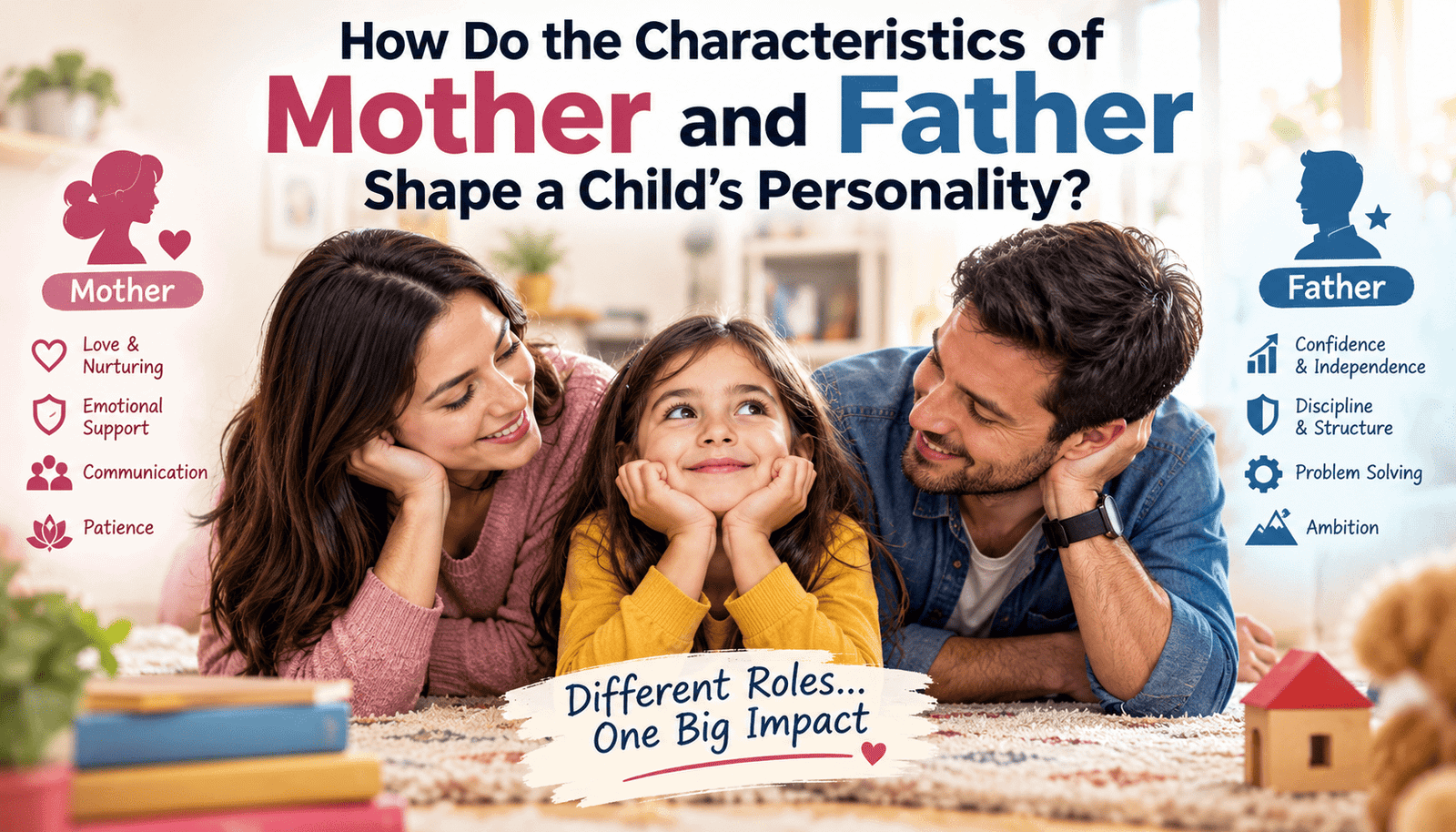
The characteristics of a mother and father can influence a child’s personality through genetics, emotional support, communication, discipline, and everyday behavior. Children may inherit certain temperamental tendencies from their parents while also learning attitudes, habits, and social skills by observing them. However, personality is not determined by parents alone. A child’s experiences, relationships, environment, and individual temperament also play important roles in shaping who they become.
Introduction
A child’s personality develops through a combination of inherited tendencies, family relationships, everyday experiences, and the environment in which they grow up. From early childhood, children observe how their parents communicate, respond to challenges, express emotions, and treat other people. These repeated experiences can influence how children understand themselves, build relationships, and respond to different situations.
When exploring how the characteristics of mother and father shape a child’s personality, it is important to look beyond traditional assumptions about parenting. Mothers are not automatically more caring, and fathers are not naturally more disciplined or confident. Both parents can provide affection, structure, encouragement, protection, and guidance. Their influence depends on their individual personalities, parenting behaviors, relationships with the child, and the circumstances of family life.
Understanding these influences helps explain why siblings raised in the same household may develop different personalities. It also shows why positive parenting is not about creating a perfect child. Instead, it involves providing a supportive environment where children can develop independence, emotional awareness, confidence, and respect for others.
How a Mother’s Characteristics Can Influence a Child’s Personality
A mother’s personality and parenting behavior can affect how a child experiences relationships, manages emotions, and develops a sense of security. However, these influences are not exclusive to mothers. Any consistent, caring caregiver can help support a child’s development.
Emotional warmth and affection
When a mother responds to a child with affection, attention, and understanding, the child has opportunities to develop trust and emotional security. For example, if a child feels disappointed after receiving a poor school result, a supportive response can help them discuss the problem without feeling that one mistake defines their worth.
Over time, experiences like these may help children become more comfortable expressing feelings and asking for assistance. They can also learn that difficult emotions are manageable and that mistakes provide opportunities to improve.
Affection does not mean agreeing with every decision a child makes. Parents can show warmth while still setting appropriate boundaries and correcting harmful behavior. A combination of emotional support and consistent guidance can create a healthier foundation for development.
Communication and listening skills
A mother who listens carefully, asks questions, and encourages a child to explain their thoughts can help create an environment where communication feels safe. Children who experience respectful conversations may have more opportunities to practise expressing their needs, explaining disagreements, and understanding different perspectives.
For instance, when a child argues with a friend, a parent can ask what happened, how each person felt, and what could be done differently next time. This approach encourages reflection instead of teaching the child to respond to every disagreement with anger or avoidance.
Patience and emotional regulation
Children notice how adults react when plans change, mistakes happen, or disagreements arise. If a mother demonstrates patience and takes time to calm down before responding, a child can observe a practical example of emotional regulation.
Parents will sometimes become frustrated, and occasional mistakes are normal. What matters is how they respond afterward. A sincere apology, a calm explanation, and an effort to handle the next situation differently can teach children accountability and emotional maturity.
How a Father’s Characteristics Can Shape a Child’s Personality
A father’s characteristics can influence a child’s development through his relationships, everyday interactions, expectations, and behavior. Fathers can contribute to emotional security and social development just as mothers can, and the effects depend more on the quality of caregiving than on gender alone.
Confidence and independence
When a father encourages a child to try age-appropriate challenges, make choices, and learn from mistakes, he can help the child practise independence. For example, a father might allow a child to organize school materials, solve a manageable problem, or learn a new skill with guidance rather than completing every task for them.
This balance helps children understand that independence does not mean doing everything alone. They can attempt something themselves while knowing that support is available when they need it.
Constant criticism or unrealistic expectations, by contrast, may make some children reluctant to try unfamiliar tasks. Encouragement that recognizes effort, problem-solving, and improvement can help children develop a more balanced view of their abilities.
Responsibility and accountability
A father who follows through on commitments and accepts responsibility for mistakes can demonstrate what accountability looks like in daily life. Children may learn from seeing adults keep promises, respect shared responsibilities, and acknowledge when they have made a poor decision.
These lessons are especially effective when parents explain expectations clearly and apply reasonable consequences consistently. Responsibility is not developed through fear alone. Children also need opportunities to make decisions, understand consequences, and practise better choices.
Respectful behavior and relationships
The way a father treats family members, friends, colleagues, and strangers can provide a powerful example of interpersonal behavior. When children regularly observe respectful disagreement, honest communication, and consideration for other people, they gain opportunities to learn these behaviors.
The same principle applies when a father manages conflict poorly. Frequent hostility or disrespect can give children an unhealthy model of relationships. Parents can help by demonstrating that disagreement does not require insults, intimidation, or humiliation.
These influences are not limited to fathers. Children can learn the same lessons from mothers, grandparents, teachers, and other trusted adults.
The Role of Genetics in a Child’s Personality
Parenting behavior is only one part of personality development. Genetics also contributes to individual differences in temperament and personality-related tendencies.
A child may show similarities to one or both parents in areas such as activity level, emotional sensitivity, sociability, or their tendency to approach unfamiliar situations cautiously. These similarities do not mean that every inherited characteristic will appear in the same way or remain unchanged throughout life.
Personality is influenced by many genetic factors rather than a single gene for confidence, kindness, intelligence, or another complex trait. Genetic tendencies interact with experiences and surroundings, making development more complicated than simply inheriting a parent’s personality.
For example, a child who is naturally cautious may need extra time to feel comfortable in a new social setting. With patient encouragement and positive experiences, that child may gradually become more confident without losing their naturally thoughtful temperament.
Similarly, an energetic child may benefit from regular opportunities for movement, creative activities, and clear expectations. Recognizing individual differences allows parents to guide children according to their needs rather than expecting every child to behave alike.
Nature vs. Nurture: Which Has the Greater Influence?
The nature-versus-nurture discussion examines how inherited characteristics and environmental experiences work together to shape development. In reality, these influences are interconnected rather than competing explanations.
Nature refers to biological influences, including genetic differences that can contribute to temperament and personality. Nurture refers to environmental influences such as parenting, education, friendships, culture, and significant life experiences.
Consider two children who are naturally sensitive to criticism. One grows up in an environment where adults listen, explain mistakes calmly, and provide reassurance. The other frequently encounters harsh criticism without much emotional support. Their experiences may influence how they respond to feedback as they grow older.
This example does not mean that parenting determines a child’s future or that every difficult experience produces the same outcome. Children respond differently to similar environments, and supportive relationships outside the immediate family can also make a meaningful difference.
The more useful question is not whether nature or nurture wins. It is how parents can recognize a child’s individual temperament and create conditions that support healthy development.
How Parenting Styles Influence Personality Development
Parenting style describes patterns in how adults provide emotional warmth, establish expectations, communicate rules, and respond to children’s needs. These patterns can influence behavior and the skills children have opportunities to develop.
Authoritative parenting: Warmth with clear boundaries
Authoritative parenting combines emotional responsiveness with reasonable expectations. Parents explain rules, listen to a child’s perspective, and maintain boundaries appropriate to the child’s age.
For example, a parent may limit screen time while discussing the importance of sleep, schoolwork, and other activities. The child is given an explanation and an opportunity to express concerns, but the parent still maintains the agreed boundary.
This balanced approach is generally associated with positive developmental outcomes, including greater self-regulation and independence, although results vary among children and families.
Authoritarian parenting: Strict control with limited discussion
Authoritarian parenting emphasizes obedience and strict rules, often with less room for discussion. Clear boundaries can be useful, but highly controlling approaches that rely on fear or humiliation may make it harder for some children to express concerns or develop independent judgment.
The effects depend on the overall family context, the nature of the rules, and how discipline is applied. Firm guidance does not need to involve intimidation.
Permissive parenting: Warmth with few consistent limits
Permissive parenting is generally warm but provides relatively few firm boundaries. Children may have considerable freedom, but without consistent guidance, they can find it harder to practise patience, manage frustration, or understand expectations.
Parents can preserve a warm relationship while still establishing predictable routines and reasonable consequences.
Uninvolved parenting: Limited emotional support and guidance
When a parent is consistently unavailable or disengaged from a child’s needs, the child may receive less emotional support, supervision, and guidance. This can create challenges for development, although outcomes vary and supportive relationships with other adults can provide important protection.
These categories are broad descriptions, not labels that define an entire parent or family. Parents may use different approaches in different circumstances, and they can change their behavior as they learn what works for their child.
How Parents Influence Emotional Intelligence
Emotional intelligence involves recognizing feelings, understanding emotional reactions, and responding to others with appropriate awareness. Children develop these abilities gradually through experience and guidance.
Parents can help by naming emotions, listening without immediately dismissing concerns, and demonstrating healthy ways to respond to frustration. A child who becomes upset after losing a game, for instance, can be encouraged to describe the disappointment, take a break, and consider what they might try differently next time.
It is also useful to distinguish between accepting an emotion and accepting every behavior. Feeling angry is normal, but hurting another person is not an acceptable response. Parents can acknowledge the feeling while setting a clear limit on the behavior.
When both parents use respectful communication and consistent expectations, children receive a clearer example of how emotions can be managed without denying or acting aggressively on them.
The Importance of a Parent’s Behavior at Home
Children learn from what parents do as well as what they say. Everyday actions can demonstrate values such as honesty, cooperation, patience, kindness, and responsibility.
If parents encourage honesty but routinely blame others for their own mistakes, children may receive conflicting messages. When adults acknowledge their actions and try to correct problems, their behavior supports the lessons they teach.
Family conflict also matters. Parents do not need to agree about everything, and children do not need to see a household without disagreements. What can help is seeing adults handle differences respectfully, avoid involving children in adult disputes, and work toward practical solutions.
A calm and predictable home environment can support a child’s sense of security. This does not require a perfect home or a life without stress. It means making room for connection, clear expectations, repair after conflict, and reliable care.
Why Siblings Can Develop Different Personalities
Even children raised by the same mother and father can have noticeably different personalities. One sibling may be outgoing and adventurous, while another prefers quiet activities and familiar routines. These differences are normal.
Each child has their own genetic combination, temperament, experiences, interests, and relationships. Age differences can also affect family dynamics: an older child may have responsibilities that a younger sibling does not, while each child may experience different teachers, friendships, or family circumstances.
Parents may also discover that the same approach works differently for different children. A child who enjoys group activities may respond well to team projects, while a more reserved sibling may prefer a smaller group or additional time to prepare.
Fair parenting does not always mean treating every child identically. It means providing appropriate support, consistent respect, and reasonable expectations while recognizing individual needs.
Practical Ways Mothers and Fathers Can Support Healthy Personality Development
Parents do not need specialized psychological training to make everyday interactions more supportive. Small, repeated actions can provide valuable opportunities for children to practise emotional, social, and practical skills.
- Listen attentively: Give children opportunities to explain their experiences and concerns without immediately interrupting or judging them.
- Set consistent boundaries: Explain household expectations and use reasonable, age-appropriate consequences.
- Model the behavior you expect: Demonstrate honesty, patience, respect, and responsibility in everyday situations.
- Encourage age-appropriate independence: Allow children to make manageable decisions and learn from ordinary mistakes.
- Recognize effort and progress: Notice persistence, thoughtful choices, and improvement instead of focusing only on results.
- Teach emotional awareness: Help children identify feelings and choose safe, respectful ways to respond.
- Spend meaningful time together: Shared meals, conversations, reading, games, and ordinary household activities can strengthen relationships.
- Respect individual differences: Avoid comparing siblings or assuming that every child should have the same temperament and interests.
- Repair mistakes: When a parent responds unfairly or loses patience, an honest apology and a change in behavior can rebuild trust.
- Work together where possible: Agree on important rules and discuss parenting disagreements away from children when practical.
The goal is not to eliminate every challenge from a child’s life. It is to provide enough support and guidance for children to learn from challenges while feeling valued and respected.
Can Parents Change a Child’s Personality?
Parents can influence the experiences and habits that contribute to personality development, but they cannot completely control who a child becomes. A naturally quiet child does not necessarily need to become outgoing, and an energetic child does not need to adopt a reserved personality to be successful.
Instead, parents can help children develop skills that allow their existing characteristics to serve them well. A quiet child can learn to communicate confidently when needed, while an outgoing child can practise listening and respecting other people’s boundaries.
Personality can also change gradually across development as children gain new experiences, form relationships, and learn coping strategies. A child’s current behavior should not be treated as a permanent prediction of their adult personality.
Parents have the greatest practical opportunity to influence the quality of the environment they provide: whether children receive encouragement, clear boundaries, respectful communication, and opportunities to develop independence. These conditions support growth without requiring children to fit a predetermined personality ideal.
Frequently Asked Questions
1. How do the characteristics of mother and father shape a child’s personality?
A mother’s and father’s characteristics can influence a child’s personality through inherited tendencies, communication, emotional support, discipline, and everyday behavior. Their influence interacts with the child’s temperament, relationships, and wider environment.
2. Does a child inherit more personality traits from the mother or the father?
There is no general rule that children inherit more personality traits from one parent. Many personality-related characteristics involve numerous genes inherited from both biological parents, alongside environmental influences and individual experiences.
3. Can a parent’s behavior affect a child’s confidence?
Yes. Encouragement, respectful feedback, and opportunities to practise independence can support confidence. Persistent humiliation or harsh criticism may undermine confidence in some children, although outcomes depend on many factors.
4. Why do siblings have different personalities?
Siblings differ in genetic makeup, temperament, interests, relationships, and life experiences. They may also experience family rules and parental attention differently because of their ages and individual needs.
5. Which parenting style is best for personality development?
A generally supportive approach combines warmth, attentive communication, consistent boundaries, and age-appropriate independence. Authoritative parenting reflects this balance, although no single style guarantees a particular outcome for every child.
6. Can a child’s personality change as they grow older?
Yes. Personality can develop over time as children gain experiences, learn emotional skills, form relationships, and encounter new responsibilities. Early temperament may remain relevant, but it does not determine every aspect of future behavior.
7. What happens when parents have very different personalities?
Parents can have different temperaments and still provide effective care. Respectful communication, agreement on essential boundaries, and an understanding of each child’s needs can help prevent differences from creating confusing expectations.
Conclusion
The characteristics of a mother and father can play an important role in shaping a child’s personality, but their influence is not simple or identical in every family. Genetics may contribute to temperament, while relationships, communication, discipline, and everyday experiences help shape how children learn to understand themselves and interact with others.
Both parents can model kindness, confidence, responsibility, emotional awareness, and respect. The most helpful approach is to combine affection with clear boundaries, encourage independence without withdrawing support, and recognize that each child develops differently.
Ultimately, successful parenting is not about designing a particular personality. It is about creating a safe, supportive environment in which children can build their own strengths, learn from mistakes, and develop the skills they need to navigate life.
 Blessingtide.com usa
[…] is no single food that builds muscle independently. Instead, the overall eating pattern […]