

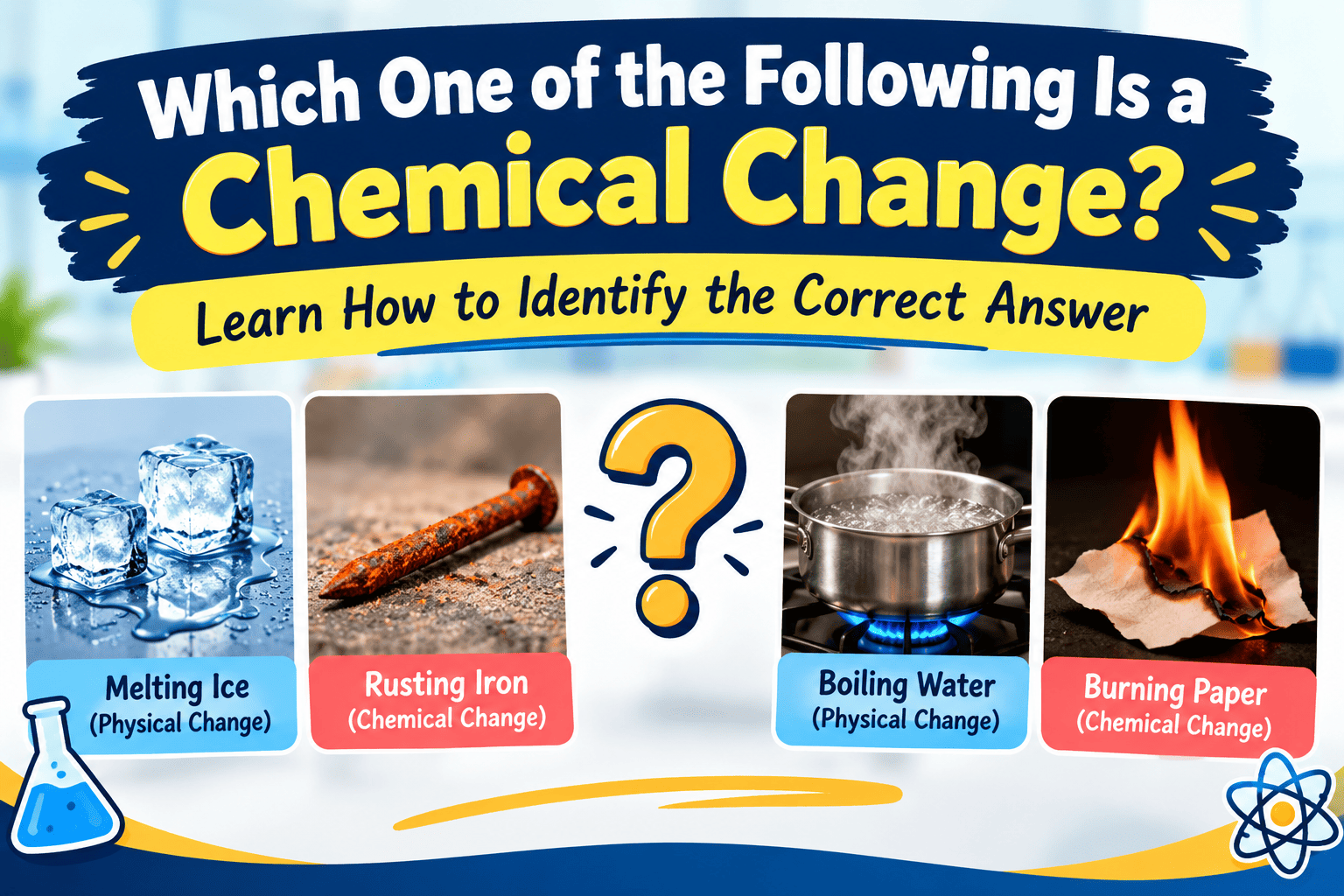
When studying chemistry, students often encounter the question, “Which one of the following is a chemical change?” This question tests your understanding of how substances change and whether a process produces a new substance. Learning to recognize chemical changes can help you answer science quizzes, prepare for exams, and understand everyday chemical reactions.
The simplest way to identify a chemical change is to determine whether a new substance forms. For example, rusting iron, burning wood, and cooking an egg are chemical changes because chemical reactions alter the composition of the original materials.
In this article, you will learn the meaning of a chemical change, explore common examples, understand the difference between physical and chemical changes, and discover practical tips for selecting the correct answer in a multiple-choice question.
What Is a Chemical Change?
A chemical change occurs when one or more substances undergo a chemical reaction and form new substances with different chemical compositions. During this process, atoms rearrange as chemical bonds break and form.
For example, when iron reacts with oxygen and moisture, rust develops. Rust contains iron compounds that differ chemically from the original iron. Similarly, burning wood produces ash, gases, and other substances that are different from the wood itself.
Chemical changes happen throughout everyday life. Cooking food, digesting meals, burning fuel, and baking bread all involve chemical reactions.
The most important feature of a chemical change is the formation of new substances, rather than a simple change in shape, size, or physical state.
Which One of the Following Is a Chemical Change? Correct Answer
Consider this common multiple-choice question:
Which one of the following is a chemical change?
A. Melting ice
B. Cutting a piece of paper
C. Rusting iron
D. Boiling water
Correct answer: C. Rusting iron
Rusting iron is a chemical change because iron reacts with oxygen in the presence of moisture to form rust. The resulting material has a different chemical composition from the original iron.
The other options represent physical changes. Melting ice changes solid water into liquid water, cutting paper changes its size and shape, and boiling water changes liquid water into water vapor. None of these processes, by itself, creates a new substance.
However, the correct answer to an actual exam question depends on the options provided. If your question contains different choices, examine each one to determine whether a chemical reaction occurs.
Five Common Examples of Chemical Changes
Understanding real-life examples makes it easier to identify chemical changes in school examinations and everyday situations.
1. Rusting of Iron
Rusting occurs when iron reacts with oxygen and moisture. This reaction produces iron oxides and related corrosion products.
The reddish-brown coating that develops on an iron nail or metal gate is evidence of a chemical reaction. Because new substances form, rusting is classified as a chemical change.
2. Burning Wood
Burning wood is another common example of a chemical change. When wood burns in oxygen, combustion produces gases, heat, light, and solid residue.
The original wood is transformed into different substances. The process cannot be reversed simply by cooling the material or changing its shape.
3. Cooking an Egg
Cooking an egg involves chemical changes in its proteins. Heat changes the proteins’ structures and interactions, causing the egg white and yolk to develop different textures and properties.
A cooked egg cannot be returned to its original raw condition simply by cooling it. This makes cooking an egg a familiar example of a chemical change.
4. Baking Bread
Baking bread involves several processes, including fermentation and chemical reactions during heating.
Yeast can produce carbon dioxide and ethanol as it consumes available sugars during fermentation. During baking, heat causes additional reactions that contribute to the bread’s color, flavor, aroma, and texture.
Because new substances form during these reactions, baking bread involves chemical changes.
5. Browning of a Cut Apple
When an apple is cut and exposed to air, its surface may gradually turn brown. This happens because enzymes help oxygen react with certain compounds in the apple, producing brown-colored substances.
This process is called enzymatic browning and is an example of a chemical change.
Chemical Change vs. Physical Change
One of the most important chemistry concepts is the difference between a physical change and a chemical change.
A physical change affects a substance’s size, shape, or physical state without changing its chemical identity. A chemical change, in contrast, produces substances with different chemical compositions.
| Chemical Change | Physical Change |
| Rusting iron | Melting ice |
| Burning wood | Boiling water |
| Cooking an egg | Cutting paper |
| Baking bread | Breaking glass |
| Browning a cut apple | Crushing an aluminum can |
| Burning natural gas | Freezing water |
For example, ice and liquid water are both made of H₂O molecules. When ice melts, the molecules remain chemically the same. The change is physical because only the state of matter changes.
When paper burns, however, combustion produces gases, ash, and other reaction products. Since the chemical composition changes, burning paper is a chemical change.
Remember that a change does not have to be dramatic to be chemical. Some chemical reactions occur slowly and produce only subtle visible effects.
Signs That a Chemical Change Has Occurred
Several observable signs can help you recognize a chemical reaction. These signs are useful clues, although no single sign automatically proves that a chemical change has taken place.
Color Change
A substance may develop a different color during a chemical reaction. For example, iron can develop a reddish-brown rust coating, while a cut apple may turn brown after exposure to air.
However, some physical changes can also affect appearance, so color change alone is not conclusive evidence.
Gas Production
A chemical reaction may release a gas, causing bubbles to appear. For instance, an acid reacting with certain carbonates can produce carbon dioxide gas.
Nevertheless, boiling water also produces bubbles without a chemical reaction. Always consider what causes the gas to form.
Temperature Change
Some chemical reactions release heat, while others absorb energy from their surroundings. These are known as exothermic and endothermic reactions, respectively.
A temperature change can indicate a chemical reaction, but temperature can also change during physical processes.
Formation of a Solid
When two solutions react, they may produce an insoluble solid called a precipitate. The formation of a new solid can be evidence that a chemical reaction has occurred.
Production of Light
Certain chemical reactions release energy as visible light. Combustion is a familiar example because burning materials can produce flames and glowing particles.
The best way to confirm a chemical change is to determine whether the chemical composition has changed and new substances have formed.
Examples of Physical Changes You Should Know
Students sometimes select the wrong answer because they assume that every visible change is chemical. The following examples help clarify the distinction.
Melting ice: Ice becomes liquid water, but its chemical composition remains H₂O.
Boiling water: Liquid water becomes water vapor. This is a change of state rather than a chemical reaction.
Cutting paper: The paper becomes smaller, but cutting does not ordinarily change its chemical composition.
Breaking glass: The glass changes shape and size while retaining its chemical identity.
Dissolving sugar in water: Sugar molecules generally remain chemically unchanged when they dissolve. The sugar can be recovered by removing the water.
Freezing water: Liquid water becomes solid ice without forming a new substance.
These examples are classified as physical changes because they do not, by themselves, change the chemical identity of the material.
How to Identify the Correct Answer in an Exam
If you encounter the question “Which one of the following is a chemical change?”, use the following steps to evaluate the available options.
Step 1: Read Every Option Carefully
Look at each process and consider what happens to the original material. Do not choose an answer merely because the material looks different afterward.
Step 2: Check Whether a New Substance Forms
Ask yourself whether the process creates a substance with a different chemical composition. This is the most important test for identifying a chemical change.
Step 3: Eliminate Common Physical Changes
Options involving melting, freezing, boiling, cutting, crushing, or breaking are generally physical changes when no chemical reaction occurs.
Step 4: Look for Chemical Reactions
Processes such as burning, rusting, cooking, and many forms of decomposition involve chemical reactions. These are often useful clues in introductory chemistry questions.
Step 5: Compare the Remaining Options
If more than one option appears to involve a chemical reaction, examine the wording carefully. Some multiple-choice questions ask for the best example, while others may contain more than one scientifically valid chemical change.
Quick memory tip: A new substance forming indicates a chemical change. A change in shape, size, or state alone usually indicates a physical change.
Why Is Rusting Iron a Chemical Change?
Rusting iron is a particularly useful example because it clearly demonstrates how a chemical reaction changes a material.
Iron reacts with oxygen and moisture over time, forming rust, which consists mainly of hydrated iron(III) oxides and related compounds. These products have different chemical properties from metallic iron.
Rusting is also different from simply bending or cutting an iron object. Bending changes its shape, whereas rusting changes its chemical composition.
This distinction explains why rusting iron is frequently used as a correct answer in basic chemistry questions about chemical changes.
Why Is Melting Ice Not a Chemical Change?
Melting ice is a physical change because the substance remains water throughout the process.
Ice contains water molecules arranged in a solid structure. When heat is absorbed, the molecules move more freely and the solid becomes liquid water. The molecular identity remains H₂O.
No new substance is produced simply by melting the ice. Therefore, melting ice is not classified as a chemical change.
Understanding this example helps students avoid confusing a visible transformation with a chemical reaction.
Frequently Asked Questions
1. Which one of the following is a chemical change?
The correct answer depends on the available options. Rusting iron, burning wood, and cooking an egg are common examples because they involve chemical changes that produce new substances.
2. What is the easiest way to identify a chemical change?
Determine whether a new substance forms. Changes in color, gas production, heat, or light can provide clues, but the chemical composition is the deciding factor.
3. Is melting ice a chemical or physical change?
Melting ice is a physical change. The ice changes from a solid to a liquid, but the substance remains H₂O.
4. Is burning paper a chemical change?
Yes. Burning paper involves combustion and produces gases, ash, and other substances that differ chemically from the original paper.
5. Is rusting iron a chemical change?
Yes. Iron reacts with oxygen and moisture to form rust, which contains new chemical compounds.
Conclusion
The question “Which one of the following is a chemical change?” becomes much easier when you understand the difference between physical and chemical changes.
A chemical change involves a reaction that produces one or more new substances. Rusting iron, burning wood, cooking an egg, baking bread, and browning a cut apple are common examples.
Physical changes, such as melting ice, boiling water, cutting paper, and breaking glass, do not ordinarily change the chemical identity of the material.
For your next chemistry test, remember one essential rule: if a process produces a new substance through a chemical reaction, it is a chemical change. Apply this principle to each answer choice, and you will be better prepared to identify the correct answer accurately.
 Blessingtide.com usa
[…] three approaches describe how a system learns. The seven models below are specific techniques or model families, and they do not all belong to […]