

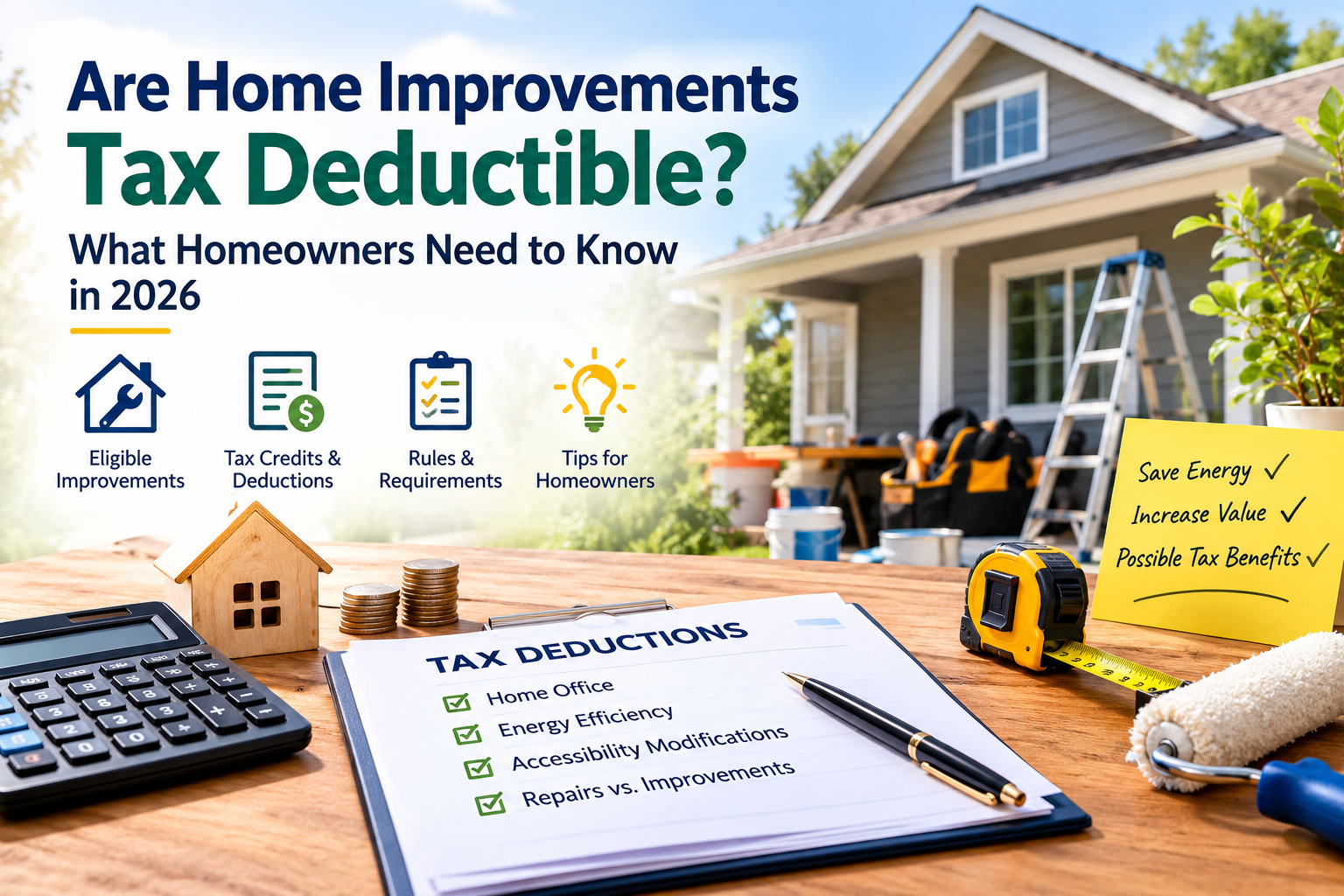
Are home improvements tax deductible? In the United States, most home improvements made to a personal residence are not immediately tax deductible. However, certain energy-efficient upgrades may qualify for tax credits under applicable rules, while improvements that increase a property’s value may help reduce taxable profit when the home is sold. Rental properties and qualifying home offices may follow different tax rules. Eligibility depends on the type of project, the property’s use, and the tax year.
Introduction
Home improvements can make a house more comfortable, attractive, and energy efficient, but they can also represent a significant financial investment. Whether you are remodeling a kitchen, replacing an old roof, installing new windows, or renovating a bathroom, it is natural to wonder whether any of these expenses can reduce your tax bill.
The answer depends on several factors, including whether the property is your primary residence, a rental property, or a home used partly for business. In the United States, the Internal Revenue Service (IRS) generally treats ordinary improvements to a personal home differently from deductible business expenses and qualifying rental property costs. Understanding these distinctions can help homeowners plan projects more carefully and avoid missing legitimate tax benefits.
1. Are Home Improvements Tax Deductible in 2026?
For most homeowners in the United States, ordinary home improvements are not deductible in the year the money is spent. Installing new flooring, upgrading kitchen cabinets, adding a bathroom, or building a deck generally does not create an immediate federal income tax deduction when the property is used exclusively as a personal residence.
However, this does not mean that renovation expenses never provide a tax advantage. Qualifying improvements can increase your home’s tax basis, which is generally the amount used to calculate your taxable gain when you sell the property. Certain projects may also qualify for specific tax incentives, depending on the applicable law and the date the improvement was installed.
It is important to distinguish between a tax deduction and a tax credit. A deduction reduces the amount of income subject to tax, while a credit generally reduces the tax you owe directly. Neither benefit is automatic simply because you spend money improving your home.
2. Which Home Improvements Usually Do Not Qualify?
Many common residential renovation projects are considered personal expenses rather than deductible costs. These expenses generally cannot be claimed as itemized deductions on a federal tax return simply because they improve your living space.
Examples commonly include:
- Kitchen remodeling and cabinet replacement.
- Bathroom renovations and new showers.
- Interior painting and decorative upgrades.
- New flooring, carpeting, and interior doors.
- Swimming pools, patios, and landscaping.
- Room additions for personal use.
- General repairs and maintenance on a personal residence.
The precise treatment can depend on the circumstances. For example, replacing a broken component to maintain the property is generally different from making a substantial improvement that adds value or extends the property’s useful life. For a personal residence, neither type of expense ordinarily creates an immediate federal income tax deduction.
Even when an expense cannot be deducted immediately, it is worth retaining records of substantial improvements. These records may become important when calculating the property’s adjusted tax basis in the future.
3. How Home Improvements Can Reduce Taxes When You Sell
One of the most important tax benefits of certain home improvements is their potential effect on capital gains when you sell your property.
Your home’s tax basis generally starts with its purchase cost, subject to applicable adjustments. The cost of qualifying capital improvements may increase that basis. A higher adjusted basis can reduce the gain calculated when the property is sold, potentially lowering the amount subject to capital gains tax.
For example, imagine you purchased a home for $300,000 and later spent $40,000 on qualifying improvements. Ignoring other adjustments, your adjusted basis could increase to $340,000. If you subsequently sold the property for $450,000, the preliminary difference would be $110,000 rather than $150,000.
This simplified example does not account for selling costs, depreciation, other basis adjustments, or any available exclusion for the sale of a principal residence. Those details can materially affect the final tax calculation.
What Counts as a Capital Improvement?
A capital improvement generally adds value, adapts a property to a new use, or substantially prolongs its useful life. Examples may include adding a room, replacing an entire roof, installing a new central heating system, or undertaking a substantial structural renovation.
Routine maintenance, such as patching a small hole or repainting a room as part of ordinary upkeep, generally does not qualify as a capital improvement for tax-basis purposes.
Keep invoices, contracts, proof of payment, and descriptions of completed work. Clear documentation makes it easier to distinguish qualifying improvements from routine maintenance when the property is sold.
4. Do Energy-Efficient Home Improvements Qualify for Tax Benefits?
Energy-efficient renovations have historically received special treatment under certain federal tax provisions. Depending on the applicable rules and installation dates, qualifying improvements have included certain insulation, exterior windows and doors, heat pumps, and other residential energy equipment.
However, homeowners should not assume that an incentive available in a previous year remains available in 2026. Federal tax legislation enacted in 2025 changed the timelines for several residential clean-energy and energy-efficiency incentives. The eligibility of a project can depend on the specific credit, the date the property or equipment was placed in service, and the requirements in effect for that tax year.
Before budgeting for a project, verify the current rules for the relevant tax year. A contractor’s description of equipment as energy efficient does not, by itself, establish eligibility for a tax credit.
Homeowners should also distinguish federal incentives from state, local, utility, or other programs. A project may qualify for a separate rebate or incentive even when a federal tax credit is unavailable, but the requirements and financial treatment can differ.
5. What Changed for Energy Tax Credits in 2026?
Tax rules can change from one year to another, making it important to check the latest requirements before starting a renovation. Under federal legislation enacted in 2025, the federal Energy Efficient Home Improvement Credit under Section 25C generally does not apply to qualifying property placed in service after December 31, 2025. The Residential Clean Energy Credit under Section 25D also generally does not apply to expenditures made after that date. <Cite refs={[“turn620815search3″,”turn620815search12”]}/>
This means homeowners planning a new project in 2026 should not automatically include these expired federal credits in their expected savings. Projects completed in 2025 may still qualify for the relevant tax year if they meet all applicable conditions, documentation requirements, and deadlines.
State incentives, local programs, and utility rebates may have different eligibility periods. Check the terms of each program before purchasing equipment or signing a contractor agreement. If you completed qualifying work in an earlier year but have not claimed an available benefit, ask a tax professional whether you can still correct or amend the relevant return.
6. Are Home Improvements on Rental Properties Tax Deductible?
Rental properties follow different tax rules from homes used entirely for personal purposes. If you own a property and rent it to tenants, certain expenses may be deductible against rental income, while the cost of substantial improvements generally must be capitalized and recovered over time under applicable depreciation rules.
For example, ordinary expenses related to managing and maintaining a rental property may qualify as deductions when they meet IRS requirements. These can include eligible maintenance, property management fees, insurance, and certain repairs. However, replacing an entire roof or adding a new bedroom would generally be treated as a capital improvement rather than an immediate repair deduction.
The distinction matters because deducting a major renovation incorrectly could lead to tax reporting problems. Keep separate records for repairs, maintenance, and capital projects, and document the date each improvement was completed or placed in service.
If you use a property partly for personal purposes and partly as a rental, the rules may require allocating expenses between the two uses. Mixed-use properties can be more complicated, so professional tax advice may be especially valuable.
7. Can You Deduct Home Improvements for a Home Office?
Some taxpayers use part of their home regularly for business. Depending on the circumstances and the applicable tax rules, qualifying home-office expenses may be deductible for eligible self-employed individuals.
However, the fact that you occasionally work from a kitchen table or spare bedroom does not automatically make renovation costs deductible. The home-office deduction generally has specific requirements concerning business use, regularity, exclusivity, and the type of work performed. Employees working remotely generally cannot claim the federal home-office deduction for unreimbursed employee expenses under current federal rules.
If you qualify for a home-office deduction, certain expenses may be allocated to the business-use portion of your home. Direct improvements to a qualifying office area may receive different treatment from improvements benefiting the entire property.
For example, renovating a room used exclusively for an eligible business may require a different tax analysis from replacing the roof on a house where you conduct some business activities. Depreciation and future home-sale calculations may also be affected.
Before claiming renovation costs, review the IRS requirements for business use of a home and keep records supporting the percentage of the property used for qualifying purposes.
8. Are Medical Home Improvements Tax Deductible?
Certain home modifications made primarily for medical care may qualify as medical expenses under federal tax rules. These can include eligible accessibility improvements, such as installing entrance ramps, modifying bathrooms, widening doorways, or adding certain safety features for a person with a medical need.
However, the rules are more specific than simply having a medical reason for a renovation. The expense generally must meet the applicable medical-expense requirements, and the deductible amount may be limited by the taxpayer’s adjusted gross income and other restrictions.
An additional consideration is whether the improvement increases the value of the property. When an improvement also adds value to the home, the amount potentially treated as a medical expense may need to be reduced by that increase in value. Some accessibility modifications may add little or no property value, depending on the circumstances.
Medical tax deductions also generally require itemizing deductions rather than claiming the standard deduction. Keep medical recommendations, contractor invoices, proof of payment, and any valuation information that supports the claim.
Because eligibility can depend on individual medical and financial circumstances, consult a qualified tax professional before including a major accessibility renovation on your return.
9. What Is the Difference Between Repairs and Improvements?
Understanding the difference between a repair and a capital improvement is essential for accurate tax reporting.
A repair generally restores a property to its previous condition without substantially adding value or extending its useful life. Examples may include fixing a leaking faucet, patching a small hole, or repairing a damaged section of flooring.
A capital improvement, by contrast, generally adds value, prolongs the property’s useful life, or adapts it to a new use. Examples include installing a new heating system, adding a bedroom, replacing an entire roof, or substantially modernizing a kitchen.
The context of the work matters. A small repair completed on its own may be treated differently from similar work performed as part of an extensive renovation. The IRS explains these distinctions in its homeowner guidance. <Cite refs={[“turn620815search0″,”turn620815search4”]}/>
For personal residences, capital improvements usually increase the home’s adjusted basis rather than create an immediate deduction. For rental or business properties, the classification may determine whether a cost is deductible now or recovered through depreciation over time.
When an invoice combines repairs with major renovation work, ask the contractor for an itemized breakdown. This makes it easier to determine the appropriate treatment for each expense.
10. How to Keep Records of Home Improvement Expenses
Good recordkeeping can help homeowners establish the cost of qualifying improvements and support tax claims where permitted. Even if a renovation does not produce an immediate tax benefit, keeping records may help when the property is sold years later.
Create a digital or physical folder for each significant home improvement. Include contractor agreements, itemized invoices, receipts, permits, payment confirmations, warranties, and relevant inspection documents. Record the completion date and describe the work performed.
You should also distinguish between the original purchase price, qualifying capital improvements, ordinary maintenance, insurance reimbursements, and any rebates or credits that may affect the property’s adjusted basis. Not every amount spent on a home can be added to its basis.
A simple spreadsheet can help organize the information.
| Record | Why it matters |
| Contractor invoices | Documents the work and its cost |
| Receipts and payment records | Shows the amount actually paid |
| Permits and inspection records | Supports the scope of major projects |
| Completion dates | Helps determine which tax-year rules apply |
| Warranty and equipment details | Helps identify the installed materials or systems |
| Tax returns and credit documentation | Supports previously claimed benefits and basis adjustments |
The IRS recommends keeping records that support the home’s basis and relevant tax calculations. <Cite refs={[“turn620815search0″,”turn620815search4”]}/>
11. Common Home Improvement Tax Mistakes to Avoid
One common mistake is assuming that every renovation qualifies for a deduction. A more expensive project does not automatically produce a larger tax benefit, and a renovation’s resale value is not the same as its tax treatment.
Another mistake is relying on outdated information. Articles written before a tax law changes may describe credits that are no longer available for new projects. Always check the tax year and effective dates before making a financial decision.
Homeowners should also avoid confusing a rebate with a tax credit, claiming the same expense twice, or treating a personal expense as a business cost without meeting the relevant requirements.
Finally, do not discard renovation records after the project is complete. A well-organized file can help you calculate your adjusted basis and substantiate eligible deductions or credits. When a project involves a rental property, business use, medical modifications, or a planned home sale, professional advice can help prevent costly reporting errors.
Conclusion
Are home improvements tax deductible? For most U.S. homeowners, the answer is no when it comes to ordinary renovations on a personal residence. Nevertheless, certain improvements can increase the home’s adjusted tax basis, and rental properties, eligible business-use areas, and qualifying medical modifications may receive different tax treatment.
Energy-efficiency incentives also require particular attention in 2026 because important federal residential credits generally ended for new qualifying property or expenditures after December 31, 2025. Homeowners should verify current federal, state, and local rules before relying on an incentive.
The best approach is to classify each project correctly, keep detailed documentation, and review the applicable tax rules before filing. A qualified tax professional can help you determine which costs matter for your circumstances and how to report them accurately.
Frequently Asked Questions
1. Are home improvements tax deductible on a primary residence?
Generally, no. Most personal renovations are not immediately deductible on a federal tax return. Qualifying capital improvements may increase the home’s adjusted tax basis, potentially reducing taxable gain when you sell.
2. Can I deduct a new roof on my house?
Usually, you cannot immediately deduct the cost of a new roof on a personal residence. However, the cost of replacing the entire roof generally qualifies as a capital improvement that increases the home’s adjusted basis.
3. Are energy-efficient home improvements tax deductible in 2026?
The federal Energy Efficient Home Improvement Credit generally ended for qualifying property placed in service after December 31, 2025. Check current state, local, and utility programs for any separate incentives that may apply.
4. Are home improvements on rental properties deductible?
Some rental repairs and operating expenses may be deductible, but substantial improvements generally must be capitalized and recovered through depreciation. The correct treatment depends on the nature of the work and the property’s use.
5. Do I need receipts for home improvements when selling my house?
Yes, retaining receipts and invoices is strongly recommended. Records of qualifying capital improvements can help establish your adjusted basis and support the calculation of taxable gain when you sell the property.
6. Can home improvements qualify as medical expenses?
Certain medically necessary home modifications may qualify under federal medical-expense rules. Eligibility depends on the nature of the expense, applicable limitations, and whether the improvement increases the home’s value.