

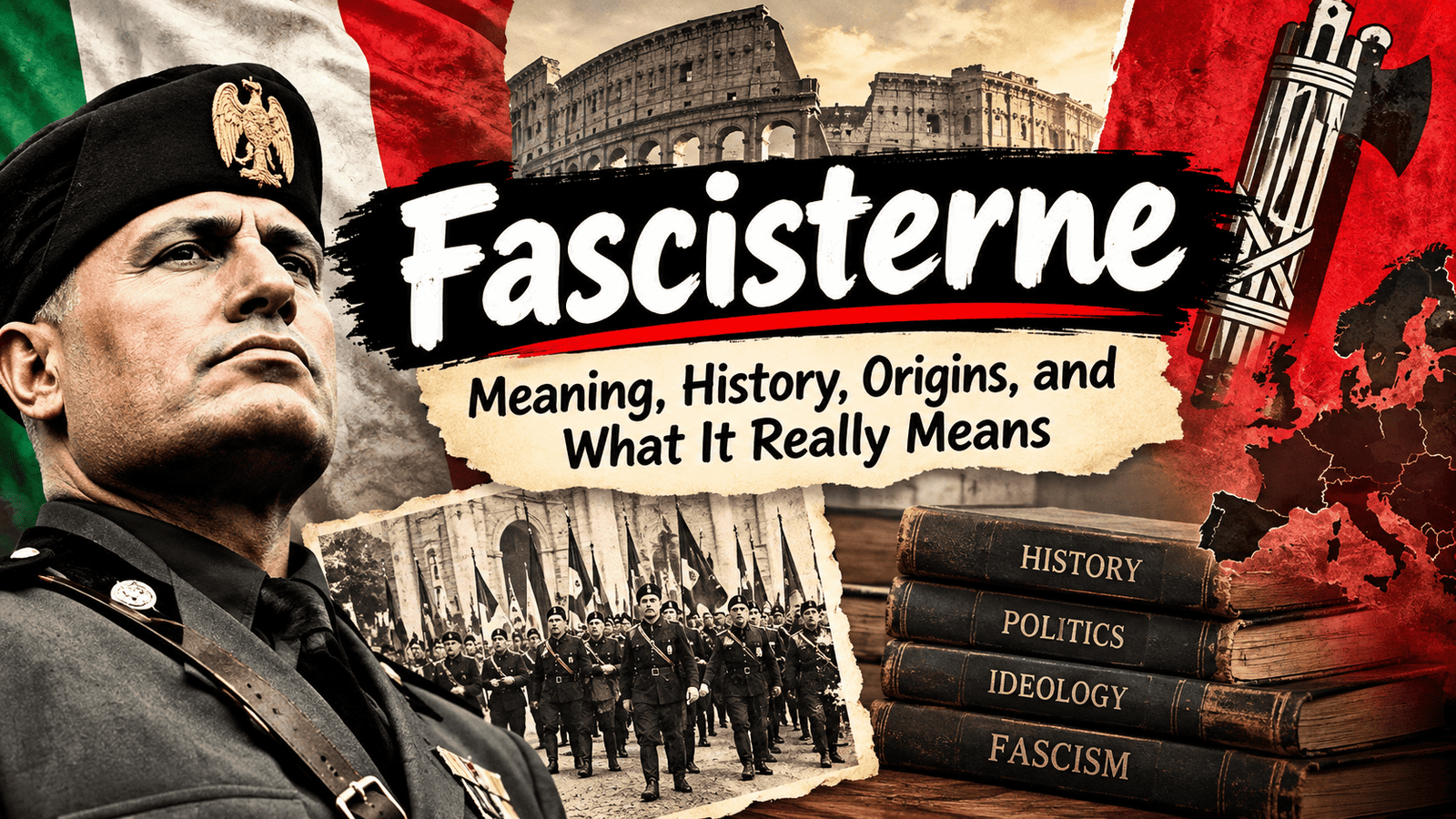
Fascisterne is a term that can refer to fascists in certain Scandinavian-language contexts. To understand the word, it is useful to know the meaning and history of fascism, a political ideology associated with extreme nationalism, authoritarian leadership, suppression of political opposition, and strong state power. The history of fascism is particularly connected with Italy, Germany, and the political turmoil of the early twentieth century.
Introduction
The word Fascisterne may look unfamiliar to English-speaking readers, but its meaning becomes easier to understand when it is considered alongside the history of fascism. The term can appear in translated historical material, political discussions, news archives, or Scandinavian-language writing.
Searching for this word can also lead people to broader questions such as what is fascism, what does the word fascist mean, and how did fascist movements develop? These questions are important because fascism is not simply another word for a strict government or an unpopular political opinion. It refers to a particular family of political movements and ideas that became especially influential during the twentieth century.
This guide explains the meaning of Fascisterne, the definition of fascism, its origins, its major characteristics, and its historical development in Europe.
What Does Fascisterne Mean?
The meaning of Fascisterne depends on the language in which it is being used. In Scandinavian contexts, the word can function as a plural reference to fascists, meaning people associated with fascist politics or movements.
The underlying concept is therefore connected to the word fascist, which generally describes a person, movement, or political system associated with fascism.
Because the word can appear in historical or translated sources, context matters. It may describe a particular group of fascists, refer to fascist political supporters generally, or appear as part of a historical account.
What Is Fascism?
So, what is fascism? In broad historical terms, fascism is an authoritarian and ultranationalist political ideology that emerged in Europe during the early twentieth century.
Fascist movements generally rejected liberal democracy, political pluralism, and many individual political freedoms. They often emphasized national unity, strong leadership, military strength, discipline, and loyalty to the state or nation.
There is no single definition accepted by every historian. However, the combination of extreme nationalism, authoritarian leadership, political repression, mass mobilization, and hostility toward democratic institutions is commonly associated with fascist movements.
Fascism Definition: A Clear Explanation
A practical fascism definition describes fascism as a form of far-right authoritarian politics that places the nation or perceived national community above individual political interests and supports concentrated political power.
Historically, fascist movements attempted to create a highly unified society by portraying political disagreement as a threat to national strength. Opposition parties, independent organizations, journalists, labor groups, and political activists could become targets of repression.
The definition of fascism therefore involves more than nationalism alone. A country can be nationalistic without being fascist. Historians normally examine the broader political ideology, methods of organization, attitude toward democracy, leadership structure, and treatment of political opponents.
Fascist Meaning and the Word Fascist
The fascist meaning is closely connected with the political history of fascism. A fascist can broadly refer to a supporter of fascist ideology or a member of a fascist political movement.
The term became especially associated with Benito Mussolini’s movement in Italy. Over time, it was also applied to other movements that shared important characteristics with Italian Fascism.
However, the word should be used carefully. Calling every authoritarian leader or political opponent “fascist” can make historical discussion inaccurate. A proper fascist definition requires attention to the political characteristics and historical context involved.
Where Did Fascism Begin?
Modern fascism emerged in Italy after the First World War. Italy had experienced enormous social, political, and economic difficulties, and many people were dissatisfied with the existing political system.
Benito Mussolini became the central figure in the development of Italian Fascism. In 1919, he established the Fasci Italiani di Combattimento, a political movement that eventually developed into the National Fascist Party.
The movement appealed to people who wanted stronger government, national revival, and an end to what they viewed as political disorder. Mussolini’s movement later transformed Italy into a dictatorship.
The Origin of the Word Fascism
The word fascism has an interesting linguistic history. It is derived from the Italian fascismo, which was associated with Mussolini’s political movement.
The word is related to the Latin fasces, a bundle of rods that symbolized authority in ancient Rome. Fascist Italy used Roman imagery to communicate ideas about power, unity, discipline, and national greatness.
This symbolism was not accidental. Fascist movements often used historical images, uniforms, ceremonies, flags, slogans, and public gatherings to create a powerful sense of collective identity.
Fascism and Nationalism
The relationship between fascism and nationalism is particularly important when studying the ideology. Fascist movements generally promoted an intense form of nationalism in which the interests of the nation were presented as more important than individual political interests.
This nationalism often involved the creation of an idealized national identity. People who were considered outsiders, enemies, or threats could be portrayed as responsible for social problems.
It is important, however, to distinguish ordinary patriotism or nationalism from fascism. National pride by itself does not make a movement fascist. Fascism historically combined nationalism with authoritarianism, political repression, mass mobilization, and other distinctive characteristics.
Fascism and Authoritarian Power
Another major relationship is between fascism and authoritarianism. Fascist movements historically supported powerful centralized leadership and rejected the idea that political authority should be divided among competing institutions.
Mussolini’s government gradually removed democratic checks and restrictions on executive power. Political opposition became increasingly difficult, while the state gained greater control over public and political life.
This concentration of authority is one reason historians study fascism when examining the dangers of weakened democratic institutions.
The Rise of Italian Fascism
Italian Fascism gained significant political influence during a period of instability following the First World War. Economic problems, labor unrest, political violence, and fear of revolutionary movements contributed to an atmosphere in which Mussolini could present himself as a strong alternative.
In 1922, Mussolini became prime minister following the March on Rome. Over the following years, he dismantled important democratic institutions and established an authoritarian dictatorship.
The Italian experience became historically important because it provided one of the earliest examples of a modern fascist government.
Fascism in Germany
When people search for fascism german, they are often looking for information about fascism and Germany. The subject is primarily associated with Adolf Hitler and the Nazi Party.
Nazi Germany shared several characteristics with other fascist movements, including extreme nationalism, authoritarian leadership, mass political mobilization, propaganda, militarism, and the destruction of democratic institutions.
At the same time, Nazism had distinctive characteristics, particularly its extreme racial ideology and antisemitism. The Nazi regime ultimately carried out the Holocaust, a systematic campaign that resulted in the murder of approximately six million Jews, alongside the persecution and murder of millions of other victims.
For that reason, the history of fascism in Germany must be studied within the specific context of Nazism rather than treating all forms of fascism as identical.
Fascism and Political Violence
Political violence was an important part of several historical fascist movements. In Italy, Fascist squads attacked political opponents, labor organizations, socialists, and other groups.
Violence could serve several purposes: intimidating opponents, demonstrating strength, disrupting political organizations, and creating an atmosphere in which authoritarian control appeared necessary.
The historical connection between fascism and political violence is one reason the ideology is studied in relation to democratic stability and political extremism.
Fascism and Propaganda
Propaganda played a major role in fascist political systems. Governments and movements used newspapers, posters, radio, public speeches, ceremonies, education, and mass gatherings to influence public opinion.
Propaganda often presented the leader as a symbol of national strength while portraying political opponents as enemies of the country.
The goal was not simply to provide information. Propaganda could create emotional loyalty, simplify complicated political problems, and encourage people to view society through a rigid division between supporters and enemies.
Common Spelling Confusion: Facism and Facist
People sometimes search for facism or facist when they mean fascism or fascist. These are common misspellings of the words.
The standard English spellings are fascism and fascist. The spelling with “sc” is the accepted form in English-language historical and academic writing.
Understanding this distinction is useful when researching the subject because searching with an incorrect spelling can sometimes produce different or less reliable results.
How Is Fascism Different From Authoritarianism?
Fascism and authoritarianism overlap, but they are not necessarily identical concepts.
Authoritarianism broadly describes political systems in which power is concentrated and political freedoms are significantly restricted. Fascism is a particular political tradition that historically combines authoritarian power with extreme nationalism, mass political organization, political mythmaking, and other characteristics.
This distinction matters because not every dictatorship should automatically be described as fascist. Historical classification requires more detailed examination.
How Is Fascism Different From Democracy?
Democratic political systems generally depend on competitive elections, political pluralism, institutional checks, civil liberties, and the peaceful transfer of power.
Historical fascist regimes moved in the opposite direction. They restricted political competition, weakened independent institutions, suppressed opposition, and concentrated power around a ruling leader or movement.
This fundamental difference helps explain why the history of fascism is frequently discussed alongside the development and protection of democratic institutions.
Why Did Fascist Movements Gain Support?
There was no single reason why fascist movements gained support. Economic hardship, political instability, social conflict, fear of revolution, nationalism, dissatisfaction with established parties, and the desire for strong leadership all played roles in different countries.
Fascist movements were also skilled at political messaging. They presented themselves as movements capable of restoring order and national pride.
Understanding these factors does not justify fascism. Instead, it helps explain how political movements can gain influence during periods of crisis.
Why Is Fascism Still Studied Today?
Fascism remains an important subject for historians, political scientists, educators, and researchers because its history offers lessons about political institutions and social instability.
Studying fascism can help people understand how democratic systems can be weakened, how propaganda can influence public opinion, and how political violence can become normalized.
It also encourages more careful political language. Instead of using “fascist” simply as an insult, understanding its historical meaning allows people to use the term more accurately.
Define Fascism in Simple Terms
If someone asks you to define fascism in simple language, it can be described as an authoritarian political ideology associated with extreme nationalism, concentrated leadership, suppression of political opposition, and rejection of democratic pluralism.
That short explanation is useful, but it should not replace historical context. Fascism developed differently across countries and movements, and scholars continue to debate the precise boundaries of the term.
Frequently Asked Questions
What does Fascisterne mean?
In relevant Scandinavian-language contexts, Fascisterne can refer to fascists as a group. The exact meaning depends on the source and language.
What is fascism?
Fascism is an authoritarian and ultranationalist political ideology that historically opposed liberal democracy and emphasized centralized power, national unity, and strong leadership.
What is the fascist meaning?
The term generally refers to something connected with fascism or to a person who supports or belongs to a fascist movement.
What is the definition of fascism?
The definition of fascism generally includes authoritarian leadership, extreme nationalism, suppression of political opposition, mass political mobilization, and hostility toward liberal democratic institutions.
Is “facism” the correct spelling?
No. Facism is a common misspelling. The standard English spelling is fascism.
Is “facist” the correct spelling?
No. Facist is a common misspelling. The standard spelling is fascist.
What is fascism in Germany?
The phrase generally refers to the history of fascist-related politics in Germany, most notably Nazism under Adolf Hitler. Nazi ideology had distinctive racial and antisemitic characteristics.
Why is fascism important in history?
Fascism is important because fascist and related authoritarian movements dramatically changed twentieth-century politics and contributed to war, repression, genocide, and the destruction of democratic institutions.
Conclusion
The meaning of Fascisterne becomes clearer when it is examined alongside the history of fascism. In relevant Scandinavian contexts, it can refer to fascists, while the broader subject leads into the history of one of the most influential and destructive political movements of the twentieth century.
The definition of fascism involves more than strong government or nationalism. Historically, fascism has been associated with authoritarian leadership, extreme nationalism, suppression of political opposition, political mobilization, propaganda, and hostility toward democratic pluralism.
From Italian Fascism under Mussolini to Nazi Germany, the historical record shows why understanding the term requires context and careful language. Learning the fascist meaning, origins, and development of the ideology provides a more accurate foundation for understanding political history today.
 Blessingtide.com usa