
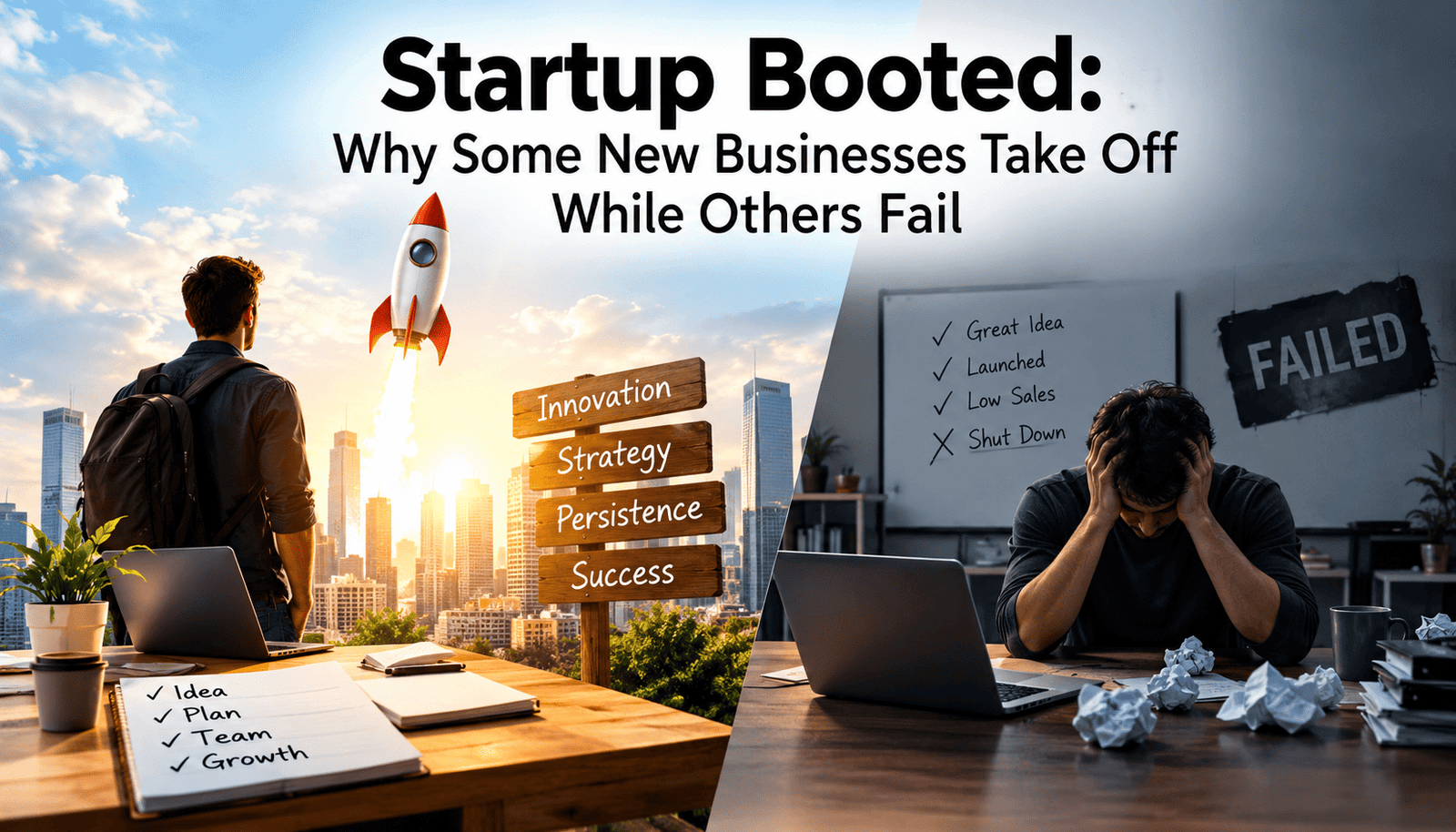
“Startup Booted” is an ambiguous search phrase rather than a universally recognized business term. It may refer to StartupBooted, a startup consulting brand, an informal description of a business or founder being removed from a platform or program, or a searcher’s intended reference to a bootstrapped startup. Identifying the context is essential before interpreting the phrase or deciding which information is relevant.
Introduction: One Search Term, Several Possible Meanings
Searching for Startup Booted can lead to different kinds of information. Some readers may be looking for a business service, others may have encountered a headline about a company being removed from a platform, and some may be confusing the phrase with bootstrapping—the established practice of building a business using founders’ resources and operating revenue.
These interpretations are related to entrepreneurship, but they answer different questions. Someone researching a consulting provider needs to understand its services, costs, and credibility. A reader investigating a company that was booted from a marketplace needs to establish what happened and whether the business can continue operating. An entrepreneur interested in bootstrapping needs to understand how to finance a company without relying primarily on outside equity investment.
This distinction is the starting point for a useful Startup Booted resource. Rather than assuming the phrase has one fixed definition, this article examines its possible meanings, explains how to evaluate the available evidence, and offers practical examples that help readers make informed decisions.
What Does Startup Booted Actually Mean?
The meaning depends on where the phrase appears. “Booted” is informal language, not a precise business or legal classification. It can describe removal from an organization, marketplace, or partnership, while “booted” in a computing context can refer to a system starting up.
There is also an important distinction between the phrase “Startup Booted” and “bootstrapped startup.” Bootstrapping is a recognized business-financing concept. Startup Booted may instead be a brand name or an informal search phrase. Treating the expressions as interchangeable without checking the context can lead to inaccurate information.
| Possible interpretation | What the reader wants to know | Evidence to look for |
| StartupBooted as a business brand | What services does the company provide? | Official service pages, terms, pricing, and business identity |
| A startup being booted from a platform | Why was access removed? | An official notice, platform policy, or verified company statement |
| A founder being removed | What happened to the founder’s position? | Company announcements, filings, or credible reporting |
| A bootstrapped startup | How does the business fund its growth? | Funding disclosures, revenue information, and founder statements |
| A computer or application booting | Did the system start successfully? | Technical documentation, logs, and error messages |
The key lesson is straightforward: establish the subject first, then evaluate the relevant evidence. A business name, an informal expression, and a financing method should not be treated as the same thing simply because their wording overlaps.
StartupBooted as a Business Service: What Should You Examine?
Search results include a website using the StartupBooted name that advertises startup-related services. A third-party business article describes offerings involving investor pitch decks, financial modeling and budgeting, and fundraising strategy. These descriptions can help readers identify the type of service being discussed, but they should not automatically be treated as independent proof of quality or results. See the Startup Booted service overview published by Tycoonstory.
Anyone considering a consulting service should start by defining the problem they want to solve. A founder who needs clearer financial forecasts has a different requirement from someone who needs help presenting a business to prospective investors. Buying a broad package without identifying the actual problem can lead to unnecessary expenditure.
Investor Pitch Deck Support
A pitch deck explains a company’s problem, proposed solution, target market, business model, competitive position, financial expectations, and funding requirements. Good presentation design can make this information easier to understand, but design alone cannot establish that the business is investable.
For example, imagine a founder developing scheduling software for independent clinics. A useful pitch should explain which administrative problem the product addresses, who pays for it, how customers currently solve that problem, and what evidence supports the projected demand. A polished presentation without credible customer research or realistic financial assumptions leaves important questions unanswered.
Before hiring a pitch deck provider, request a written list of deliverables, revision limits, research responsibilities, ownership terms, and completion dates. Ask who will perform the work and whether the provider has relevant experience with businesses at a similar stage.
Financial Modeling and Budgeting
Financial modeling translates business assumptions into a structured view of possible financial outcomes. It can help founders understand expected revenue, operating costs, cash requirements, and the effect of changing assumptions.
Consider a small software company charging customers a monthly subscription. Its financial model should distinguish the number of paying customers from free users, account for payment processing and hosting expenses, and estimate the cost of acquiring and supporting each customer. If customer growth slows or cancellations increase, the model should show how that change affects cash requirements.
A useful model makes assumptions visible instead of presenting projections as guaranteed results. Founders should be able to change key inputs, understand the formulas, and explain why the assumptions are reasonable.
Fundraising Strategy
Fundraising support may involve organizing financial information, refining the company’s investment narrative, identifying suitable funding options, or preparing materials for investor discussions. However, a strategy document cannot guarantee that investors will commit money.
Before paying for this service, ask what the engagement actually includes. Does it cover preparation only, or does it include outreach? Who is responsible for investor communications? Are introductions promised, and if so, under what conditions? What evidence supports any claims about previous results?
The answers matter because fundraising preparation, introductions, investment advice, and transaction-related activities can involve different responsibilities and, depending on the jurisdiction, different regulatory requirements. Founders should seek qualified legal advice when an engagement involves investor solicitation or transaction-based compensation.
Startup Booted vs. Bootstrapping: Understanding the Difference
Bootstrapping means building a company primarily with the founder’s own resources and revenue generated by the business, rather than depending mainly on outside equity investment. It is a financing approach, not a guarantee of success.
For example, a designer might launch a small business offering website services, use existing equipment, secure several paying clients, and reinvest part of the revenue in better tools. As demand grows, the business can hire additional help when its income and workload justify the expense.
A venture-backed startup follows a different approach. It may raise money from outside investors to develop a product, hire employees, or enter a market more quickly. This can be useful for businesses requiring substantial upfront investment, although founders must consider ownership dilution, investor expectations, and the pressure to achieve agreed milestones.
Neither method is automatically superior. The appropriate choice depends on the company’s industry, capital requirements, expected growth, risk tolerance, and the founder’s objectives.
| Factor | Bootstrapped business | Venture-backed startup |
| Main funding source | Founder resources and business revenue | Outside equity investment, often alongside revenue |
| Ownership | Founders may retain more ownership | Founders share ownership with investors |
| Growth pace | Often limited by available cash and revenue | May expand faster if funding is available |
| Financial pressure | Cash flow and profitability are central | Growth targets and investor expectations may be significant |
| Decision-making | Founders generally retain more control | Governance and investor agreements can affect decisions |
| Suitable situation | A business that can grow through early sales | A business requiring substantial capital for its opportunity |
Founders should also distinguish equity investment from loans, grants, and customer prepayments. Each has different costs, conditions, and obligations. The right decision requires understanding the terms rather than choosing funding based on its label.
Why Some New Businesses Gain Traction While Others Struggle
The performance of a startup depends on whether its product meets a real need, whether customers are willing to pay for it, and whether the company can deliver that value economically. A strong idea can still fail when the business model does not work in practice.
Customer Demand Must Be Demonstrated
An entrepreneur may receive enthusiastic feedback about a new product without attracting enough paying customers to sustain the business. People can like an idea without being willing to purchase it.
Suppose a founder plans to sell reusable lunch containers to office workers. Before ordering a large quantity, the founder could interview potential customers, test product samples, and run a small pilot with transparent pricing. The results might reveal that buyers care more about leak prevention and easy cleaning than about a feature the founder originally considered essential.
This example illustrates the difference between assumptions and evidence. The goal of early research is to discover what customers value before committing too much money to production, inventory, or promotion.
Revenue Does Not Automatically Mean Profit
A company can make sales while losing money on every transaction. This happens when prices do not cover the full cost of delivering the product or service.
Imagine a small online retailer selling a product for $30. The product costs $14, packaging costs $2, shipping costs $5, and payment processing costs $1. The retailer has $8 remaining before advertising, returns, overhead, taxes, and other expenses.
If the retailer spends $10 in advertising to acquire each customer, the sale may generate a negative contribution before overhead is even considered. Increasing sales through the same campaign could increase losses rather than solve them.
This is why founders should calculate their contribution margin, understand acquisition costs, and review the economics of each sales channel before expanding.
Operational Capacity Must Keep Pace With Growth
More customers can expose weaknesses in delivery, customer support, quality control, and inventory management. A business that can serve ten customers reliably may struggle when it suddenly receives one hundred orders.
For example, a meal-preparation business may attract customers through social media but lack sufficient staff, equipment, or delivery capacity. Delays and inconsistent quality can damage customer trust, even when demand is genuine.
The solution is not necessarily to avoid growth. It is to build repeatable processes, identify capacity limits, and expand when the business can meet its commitments consistently.
What Happens When a Startup Gets Booted From a Platform?
When a startup is described as being booted from a platform, the first question is which access or relationship was removed. A marketplace may suspend a seller account, an app store may remove an application, or an accelerator may end a company’s participation in its program. These situations have different consequences.
Removal from one platform does not necessarily mean that the entire company has failed. A business may still have customers, employees, intellectual property, and other sales channels. However, the impact can be serious if the company depends heavily on the affected platform for revenue or customer access.
Consider a hypothetical software company that distributes its application through one marketplace. If its listing is suspended, new customers may no longer be able to discover or download the product through that channel. The company must establish the stated reason, review the applicable rules, and determine whether an appeal or correction is available.
Its response should be based on the actual notice rather than speculation. If the issue involves a policy violation, the company should identify the relevant requirement and address it. If the removal appears to be an error, it should collect the necessary documentation and use the platform’s official review process.
Businesses can reduce their exposure to platform dependency by maintaining appropriate customer communication channels, keeping lawful copies of their own business records, and developing alternative acquisition routes where practical. These measures do not eliminate platform risk, but they can make the company less vulnerable to the loss of a single distribution channel.
A Practical Framework for Evaluating a Startup Service
Before purchasing startup consulting, founders should assess the provider in the same way they would evaluate any important business expense. The following framework separates the need for a service from the provider’s marketing claims.
Step 1: Define the problem. Write down the specific decision or task you need help with. Examples include preparing a cash-flow forecast, organizing an investor presentation, or evaluating funding options.
Step 2: Verify the provider. Confirm the exact website, contracting business, people responsible for the work, and available evidence of relevant experience. A similar business name or domain does not establish common ownership.
Step 3: Request a written scope. The agreement should specify deliverables, deadlines, fees, revision limits, confidentiality arrangements, and ownership of completed work.
Step 4: Check the assumptions. If the service includes financial projections, ask for the underlying assumptions and editable calculations. If it includes a pitch deck, confirm whether market research and financial analysis are included or whether the provider only handles presentation design.
Step 5: Compare alternatives. Determine whether the same task can be completed internally, through a qualified independent professional, or with a more limited engagement.
Step 6: Evaluate the expected value. Consider what decision the service will help you make, which risks it may reduce, and how you will judge whether the work has met its objectives.
A provider should be willing to explain the scope and limitations of its work clearly. Be cautious of guarantees of investment, unsupported performance claims, unclear fees, or pressure to make a quick payment.
How to Research Startup Booted Without Confusing Facts and Claims
A useful article about an ambiguous keyword should distinguish verifiable information from interpretation. This is especially important when the keyword may refer to a commercial service.
Start with the official website when checking what a business says it offers. Service pages can establish the provider’s advertised scope, but they do not independently prove customer satisfaction, financial performance, or investment outcomes.
Next, look for independent evidence. Relevant material may include credible reporting, publicly available corporate records where applicable, professional biographies, documented case studies, and customer references that can be checked. Consider whether a testimonial explains the work performed and the outcome, or simply provides general praise.
Pricing should also be handled carefully. If a service page displays a starting price, describe it as an advertised starting price and check when it was published. Do not present it as a guaranteed final quotation or assume that similarly named websites charge the same amount.
For readers researching a startup’s removal from a platform, prioritize official notices and statements from the parties involved. Independent reporting can help establish context, while social media speculation alone is not sufficient to prove why a decision was made.
This evidence-first approach is more useful than repeating broad claims about startup success. It helps readers determine what is known, what remains uncertain, and which questions still need answers.
Frequently Asked Questions
What is Startup Booted?
Startup Booted is an ambiguous phrase that may refer to a commercial brand, an informal description of a startup being removed from a platform or program, or a search for bootstrapping-related information. The context determines the intended meaning.
Is Startup Booted the same as bootstrapping?
No. Bootstrapping is an established method of funding and growing a business primarily through founder resources and operating revenue. Startup Booted may be a brand name or an informal expression, so the two should not automatically be treated as equivalent.
What services does StartupBooted advertise?
A third-party article describing StartupBooted reports services related to pitch deck design, financial modeling and budgeting, and fundraising strategy. Readers should check the provider’s current official service pages and written terms before relying on specific offerings or prices.
Does getting booted from a platform mean a startup has failed?
Not necessarily. A startup may lose access to a particular marketplace, application store, accelerator, or business relationship while continuing to operate elsewhere. The impact depends on the reason for removal and how dependent the company is on that channel.
How can founders evaluate a startup consulting provider?
Founders should verify the contracting business, identify who will perform the work, request a detailed scope and written fees, check relevant experience, and clarify what the service does not include. Claims about funding outcomes should be treated cautiously unless supported by reliable evidence.
Is bootstrapping always better than raising investment?
No. Bootstrapping can preserve ownership and encourage careful spending, but it may limit the speed or scale of expansion. Outside investment can provide additional capital but may involve ownership dilution and investor expectations. The right choice depends on the business model and funding requirements.
How can this article better match the Startup Booted search intent?
The most important step is to determine which meaning the intended audience is searching for. If the target is a specific company, the article should prioritize verified company details and service information. If the target is a general business concept, it should define the concept accurately and explain how it differs from established terms.
Conclusion: Get the Meaning Right Before Making a Decision
Startup Booted is a useful example of why keyword research must go beyond choosing a phrase and repeating it throughout an article. The wording can point to a commercial service, an informal business event, or a different concept that the searcher has in mind.
Readers benefit most when an article identifies these possibilities, separates evidence from assumptions, and gives them a practical way to evaluate the information. Founders researching services should verify providers and their terms. Entrepreneurs studying bootstrapping should compare funding approaches against their actual needs. Readers investigating a startup’s removal should seek reliable evidence about the specific event.
The central principle is simple: accurate interpretation comes before advice. By answering the intended question directly and supporting important claims with verifiable sources, an article can provide greater value than a generic discussion of startup success and failure.
 Blessingtide.com usa