

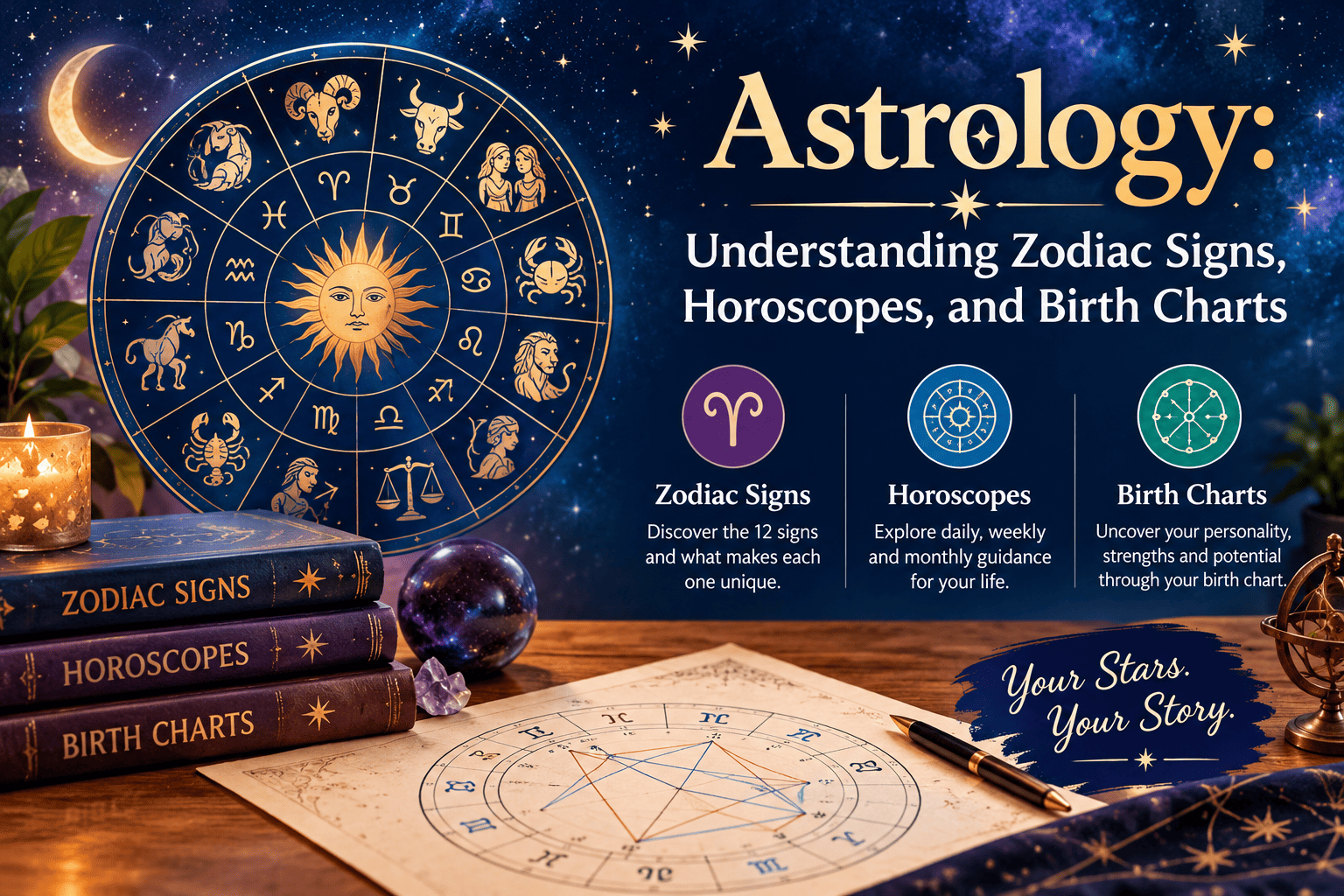
Astrology is a traditional belief system that interprets the positions of the Sun, Moon, planets, and other celestial objects in relation to human experiences. It includes zodiac signs, daily horoscopes, birth charts, and astrological compatibility. Many people explore astrology for entertainment, cultural interest, or personal reflection. However, scientific research has not established that planetary positions can reliably predict personality traits or future events.
Introduction to Astrology
Astrology has fascinated people for thousands of years. From ancient civilizations observing the night sky to modern readers checking daily horoscopes, this practice has remained a recognizable part of human culture. It connects celestial movements with symbolic interpretations of personality, relationships, opportunities, and life experiences.
Today, astrology is widely discussed online, in magazines, and on social media. Beginners often start by discovering their zodiac signs, while others explore detailed birth charts and planetary placements. Understanding the basic concepts can help readers appreciate astrology’s history and cultural significance without treating every prediction as a proven fact.
1. What Does Astrology Mean?
Astrology is based on the belief that the positions and movements of celestial bodies may have symbolic connections with events and human behavior. Astrologers interpret the Sun, Moon, planets, and zodiac signs to create horoscopes and personalized readings.
The practice has developed across different cultures, each with its own traditions and interpretations. Western astrology, Vedic astrology, and Chinese astrology are among the best-known systems. Although their methods differ, they share an interest in interpreting patterns associated with the heavens and connecting those patterns to human life.
2. A Brief History of Astrology
The history of astrology reaches back to ancient Mesopotamia, where observers recorded celestial events and connected them with religious beliefs and political developments. Over time, astrological ideas developed through Babylonian, Greek, Roman, Indian, and other cultural traditions.
Historically, astrology and astronomy were closely connected because both involved observing celestial objects. As scientific methods developed, the two disciplines gradually separated. Astronomy became the scientific study of the universe, while astrology continued as a symbolic and interpretive tradition. Their shared history remains an important part of humanity’s relationship with the night sky.
3. Understanding the Twelve Zodiac Signs
The zodiac is one of the most recognizable parts of modern astrology. In Western astrology, the twelve signs are associated with particular periods of the year. Each sign has traditional symbolic meanings, personality descriptions, and elemental associations.
The twelve zodiac signs are Aries, Taurus, Gemini, Cancer, Leo, Virgo, Libra, Scorpio, Sagittarius, Capricorn, Aquarius, and Pisces. Many people use their Sun sign as an introduction to horoscopes and astrological readings. These classifications are meaningful within the tradition, but they should not be treated as scientifically established personality categories.
4. The Four Elements in Astrology
Western astrology groups the twelve zodiac signs into four traditional elements: fire, earth, air, and water. Each element represents a collection of symbolic characteristics used in astrological interpretation.
Fire signs are Aries, Leo, and Sagittarius. Earth signs are Taurus, Virgo, and Capricorn. Air signs include Gemini, Libra, and Aquarius, while Cancer, Scorpio, and Pisces belong to the water group. Astrologers commonly associate these elements with qualities such as enthusiasm, practicality, communication, and emotional sensitivity. These associations are interpretive traditions rather than verified psychological measurements.
5. What Is a Birth Chart?
A birth chart, also called a natal chart, is a diagram representing the calculated positions of celestial bodies at a person’s birth time and location. Astrologers use this chart to develop interpretations about identity, relationships, interests, and personal experiences.
A detailed chart generally includes the Sun sign, Moon sign, rising sign, planetary placements, astrological houses, and aspects between planets. The exact birth time can matter when calculating the Ascendant and house positions. Although birth charts can provide a framework for symbolic self-reflection, scientific evidence does not establish that they accurately determine an individual’s personality or destiny.
6. What Do Sun, Moon, and Rising Signs Represent?
In popular Western astrology, the Sun sign is traditionally associated with identity and general self-expression. It is the sign most people discover from their birthday, making it the starting point for many horoscope readers.
The Moon sign is interpreted as representing emotions and inner responses, while the rising sign, or Ascendant, is associated with outward presentation and first impressions. These interpretations form part of astrological symbolism. They can encourage people to consider different aspects of their lives, but they should not replace evidence-based approaches to understanding personality and behavior.
7. How Do Horoscopes Work?
Horoscopes are astrological interpretations based on zodiac signs or calculated planetary positions. Daily, weekly, monthly, and yearly horoscopes often discuss themes such as communication, relationships, career opportunities, and personal development.
Some horoscopes are written for all twelve Sun signs, while personalized readings may use a person’s birth chart. Their language is often broad enough to invite individual interpretation. Readers may find the messages entertaining or reflective, but horoscope predictions are not a reliable substitute for practical planning, professional advice, or careful decision-making.
8. Astrology and Love Compatibility
Relationship compatibility is a popular subject within astrological traditions. Astrologers may compare zodiac signs, Venus and Mars placements, Moon signs, or complete birth charts to interpret potential similarities and differences between two people.
For example, some traditional interpretations associate particular signs with emotional sensitivity, independence, stability, or adventurous behavior. These descriptions may provide conversation starters for couples, but they cannot reliably determine whether a relationship will succeed. Communication, respect, trust, shared values, and emotional maturity are more practical considerations when evaluating a relationship.
9. Career and Financial Astrology
Some people consult career horoscopes to explore professional interests, workplace relationships, or possible opportunities. Astrological readings may discuss leadership, creativity, communication, or financial themes according to traditional planetary interpretations.
However, planetary placements have not been shown to reliably predict employment success, investment returns, salary growth, or business outcomes. Career decisions are better informed by skills, qualifications, market conditions, experience, and realistic goals. Similarly, financial choices should be based on research, budgeting, and appropriate professional guidance rather than horoscope predictions.
10. Western Astrology vs. Vedic Astrology
Western astrology and Vedic astrology are two influential astrological traditions. Western astrology commonly uses the tropical zodiac, while Vedic astrology, also known as Jyotish, generally uses the sidereal zodiac and incorporates its own interpretive methods.
Vedic readings may place particular emphasis on planetary periods, birth-chart houses, and the Nakshatras, or lunar mansions. Western interpretations often focus on zodiac signs, planetary aspects, and psychological or symbolic themes. Both systems have long cultural histories, but neither has been scientifically established as a dependable method for predicting individual outcomes.
11. Astrology vs. Astronomy
Although their names are similar, astrology and astronomy serve different purposes. Astronomy is a scientific discipline that investigates celestial objects, planetary motion, galaxies, and the physical processes operating throughout the universe.
Astrology interprets celestial positions through a traditional belief system. Astronomers use observations, mathematical models, and testable explanations to study the cosmos. By contrast, astrology’s claims about personality and future events have not demonstrated reliable predictive power under scientific testing. Understanding this distinction makes it easier to explore astrology while appreciating the evidence-based knowledge provided by modern astronomy.
12. Why Are People Interested in Astrology?
Astrology remains popular because it offers familiar symbols and a structured way to think about personal experiences. Reading a horoscope can feel entertaining, provide a conversation topic, or encourage someone to pause and reflect on their priorities.
Social media has also made zodiac content easier to discover and share. Personality descriptions, compatibility discussions, and monthly forecasts frequently circulate across online communities. Some readers enjoy astrology as a cultural tradition, while others approach it spiritually. Its popularity, however, should not be confused with scientific proof that its interpretations are accurate.
13. Can Astrology Predict the Future?
Astrologers sometimes offer predictions about relationships, career changes, emotional experiences, or upcoming opportunities. Such predictions may sound specific, but their accuracy has not been reliably established through controlled scientific research.
People can also remember predictions that appear correct while overlooking those that do not match their experiences. Broad statements may feel personally meaningful because readers connect them with their own circumstances. For this reason, future-oriented readings are best approached with curiosity rather than certainty. Important decisions should rely on observable facts, informed judgment, and practical planning.
14. How to Explore Astrology as a Beginner
Beginners can start by learning the twelve zodiac signs and understanding the difference between Sun signs, Moon signs, and rising signs. Exploring the history of different astrological traditions can also provide useful cultural context.
If you want to examine a birth chart, you will generally need your birth date, approximate or exact birth time, and birthplace. You can then learn how astrologers interpret planetary positions and chart houses. Treat the results as symbolic interpretations rather than fixed descriptions of who you are. Protect your personal information when using online chart calculators, and avoid paying for services that promise guaranteed outcomes.
15. Is Astrology Worth Exploring?
Astrology can be an interesting subject for people who enjoy mythology, symbolism, cultural history, and personal reflection. Learning about its traditions may help readers understand why zodiac signs and horoscopes have remained part of popular culture for so long.
The most useful approach is to maintain a balanced perspective. Enjoying a horoscope does not require accepting every claim it makes. You can explore astrological ideas while recognizing the difference between personal belief and scientific evidence. Keeping this distinction clear allows you to appreciate the subject without allowing unsupported predictions to control important choices.
Conclusion
Astrology connects traditional interpretations of celestial positions with ideas about personality, relationships, and everyday experiences. Its major concepts include zodiac signs, birth charts, horoscopes, planetary placements, and compatibility readings. Different cultures have developed their own systems, creating a diverse and historically significant tradition.
Although many people find astrology entertaining or personally meaningful, scientific research has not demonstrated that it can reliably predict human behavior or future events. Explore the subject with an open mind, consider its cultural background, and use evidence-based reasoning for important decisions.
Frequently Asked Questions
1. What is astrology in simple words?
Astrology is a belief system that interprets the positions of celestial bodies as symbols connected with human experiences, personality, and possible life events.
2. What are the twelve zodiac signs?
The twelve Western zodiac signs are Aries, Taurus, Gemini, Cancer, Leo, Virgo, Libra, Scorpio, Sagittarius, Capricorn, Aquarius, and Pisces.
3. Is astrology scientifically proven?
No. Scientific research has not established that astrological signs or birth charts can reliably predict personality, compatibility, or future events.
4. What information is needed to create a birth chart?
A birth chart generally requires your date of birth, birth time, and birthplace. An accurate birth time is particularly important for calculating the rising sign and astrological houses.