

Introduction
Every successful business begins with an idea. It could be a unique brand name, an innovative product, an original design, a software application, or a creative piece of writing. However, an idea becomes truly valuable when it can be developed, protected, and used to create something meaningful. This is where intellectual property plays an important role.
In today’s competitive digital economy, creativity and innovation can become powerful business assets. Companies rely on distinctive brands, inventors develop new technologies, and creators produce original content that attracts audiences. Without an understanding of intellectual property, these valuable creations may be copied, misused, or commercialized by others without appropriate permission.
Intellectual property helps individuals and businesses establish ownership over qualifying creations, control certain forms of commercial use, and explore opportunities to earn revenue. Understanding how it works is essential for entrepreneurs, freelancers, artists, inventors, and organizations that want to turn original thinking into long-term value.
What Is Intellectual Property?
Intellectual property, commonly known as IP, refers to creations of the human mind that receive legal protection under applicable intellectual property laws. These creations may include inventions, literary works, artistic designs, brand names, logos, and confidential business information.
Unlike physical property, such as a building or a vehicle, intellectual property is generally intangible. Its value comes from originality, innovation, reputation, usefulness, or the commercial advantage it provides.
For example, a business may own the equipment used to manufacture a product while separately owning a trademark associated with its brand. Similarly, a software company may own its computers and office furniture while also holding intellectual property rights in its original software code, product name, and visual designs.
Intellectual property rights can give owners the ability to control particular uses of protected creations, authorize others to use them, and take legal action when applicable rights are infringed.
However, not every idea automatically qualifies for every form of protection. The requirements depend on the type of intellectual property, the relevant law, and the circumstances of the creation.
How Creative Ideas Become Valuable Assets
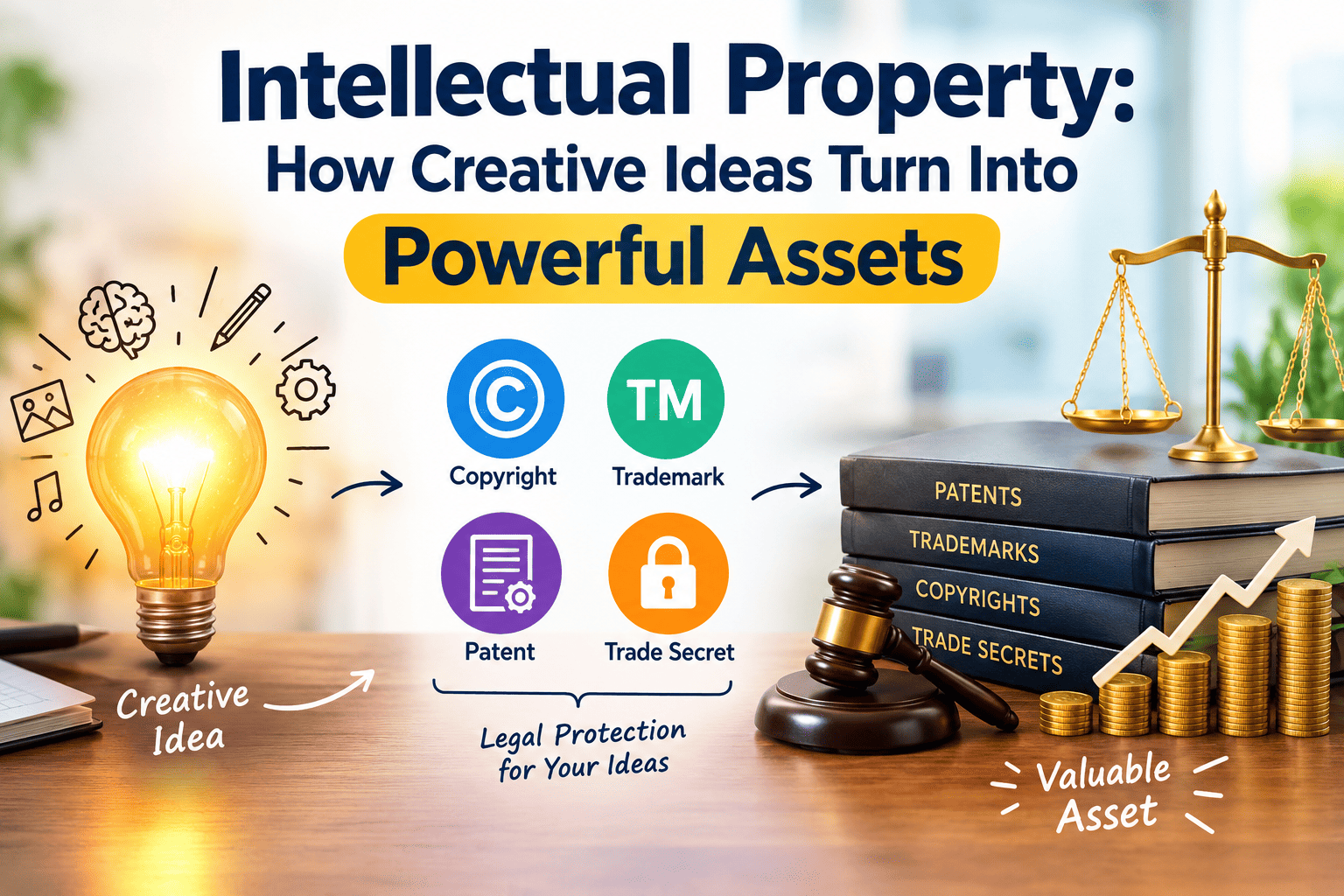
A creative idea does not necessarily have immediate financial value. It often becomes an asset through development, practical application, legal protection, and commercial use.
The process usually involves several stages.
1. Developing an Original Idea
The first stage is identifying a problem, opportunity, or creative possibility. An entrepreneur might develop a new product concept, a designer might create a distinctive visual identity, or a writer might produce an original educational resource.
At this stage, the creator should document the development process and identify what makes the creation different from existing alternatives.
2. Turning the Idea Into Something Useful
An idea becomes easier to evaluate when it takes a practical form. This might be a working prototype, a completed manuscript, a software program, a product design, or a recognizable brand identity.
The form of the creation matters because different intellectual property rights protect different things. Copyright generally protects original expression rather than an abstract idea, while patent protection may be available for qualifying inventions that satisfy legal requirements.
3. Identifying the Right Protection
The next step is determining which intellectual property rights may apply. An invention may qualify for patent protection, a brand name may be eligible for trademark protection, and original written content may receive copyright protection.
Some creations may qualify for multiple types of protection at the same time.
4. Creating Commercial Opportunities
Once a creation has been developed and the relevant rights have been identified, its owner may explore ways to generate value. These opportunities can include selling products, licensing intellectual property, entering partnerships, or building a recognizable business around the creation.
5. Managing and Maintaining the Asset
Intellectual property requires ongoing management. Businesses may need to renew registrations, monitor potential infringement, protect confidential information, maintain records, and review licensing agreements.
When managed effectively, intellectual property can support business growth and help preserve the competitive advantages associated with original work.
What Are the Main Types of Intellectual Property?
Intellectual property includes several distinct categories. Each protects a different aspect of creativity, innovation, or commercial activity.
1. Patents: Protecting New Inventions
A patent is a legal right that may be granted for an invention that meets the applicable requirements. Depending on the jurisdiction, these requirements commonly include novelty, an inventive step or non-obviousness, and industrial applicability or utility.
Patents can cover qualifying products, machines, technical processes, and other inventions.
Example: An inventor develops a new mechanism that makes a certain type of medical device operate more efficiently. If the invention satisfies the relevant legal requirements, the inventor may be able to seek patent protection.
A patent can provide an opportunity to commercialize an invention, license it to another company, or prevent certain unauthorized uses within the scope of the granted rights.
Patent protection is generally limited in duration and territorial scope. A patent granted in one country does not automatically provide worldwide protection.
2. Trademarks: Building a Recognizable Brand
A trademark distinguishes the goods or services of one business from those of other businesses. It may consist of a word, logo, symbol, slogan, or another sign that qualifies under the applicable law.
Strong trademarks help customers recognize a business and distinguish its products from competing offerings.
Example: A startup develops a distinctive name and logo for its clothing brand. Protecting eligible brand elements through trademark law may help prevent confusingly similar uses by competitors.
A trademark can become an important business asset as customer recognition and brand reputation grow. Depending on the jurisdiction, registration, continued use, and renewal requirements may affect the duration of protection.
3. Copyright: Protecting Original Creative Work
Copyright protects qualifying original expressions of ideas. Examples commonly include books, articles, photographs, music, films, illustrations, artwork, and software code.
It generally does not protect an abstract idea, fact, method, or concept by itself. Instead, it protects the original way an idea is expressed.
Example: A photographer takes an original photograph for a commercial website. Copyright may protect that photograph against certain unauthorized copying and uses, subject to applicable exceptions and limitations.
In many countries, copyright protection arises automatically when qualifying work is created, although registration or other formalities may provide additional benefits in some jurisdictions.
Copyright can help creators earn income through sales, publishing agreements, licensing, and other authorized uses of their work.
4. Trade Secrets: Protecting Confidential Business Information
Trade secrets are commercially valuable information that remains confidential and is protected through appropriate measures. Depending on the applicable law, the information must generally have value because it is secret and be subject to reasonable steps to preserve that secrecy.
Examples may include confidential formulas, manufacturing methods, supplier information, internal processes, and certain business strategies.
Example: A food manufacturer develops a distinctive recipe and limits access to it through confidentiality agreements, restricted records, and internal security procedures.
Unlike patents, trade secrets do not generally require registration. However, secrecy is essential. Protection may be lost if the information becomes publicly known or is not adequately safeguarded. Trade secret law also does not necessarily prevent independent development or lawful reverse engineering.
5. Industrial Designs: Protecting Product Appearance
Industrial design protection generally covers the ornamental or aesthetic features of a product, rather than its underlying technical function.
These features may include a product’s shape, configuration, pattern, or decorative appearance, depending on local law.
Example: A company creates a distinctive exterior design for a desk lamp. If the design meets the relevant requirements, the company may be able to protect its appearance against qualifying unauthorized copying.
Design protection can be particularly valuable in industries such as fashion, furniture, consumer electronics, packaging, and household products.
6. Geographical Indications: Protecting Regional Identity
A geographical indication identifies goods associated with a particular geographical origin when their qualities, reputation, or other characteristics are linked to that place.
For example, certain agricultural products, foods, and traditional goods may be recognized for their connection to a particular region.
This type of protection can help preserve regional reputations, support local producers, and distinguish qualifying products from goods that do not meet the relevant requirements.
Real-World Examples of Intellectual Property as an Asset
Intellectual property becomes easier to understand when viewed through everyday business situations.
A small clothing business: A business develops an original brand name, creates promotional photographs, and designs distinctive clothing patterns. The name may qualify for trademark protection, the photographs may receive copyright protection, and eligible product designs may be protected through industrial design law.
A software startup: A startup develops a digital application. Its original code may receive copyright protection, its brand name may qualify as a trademark, and certain technical inventions may potentially qualify for patent protection where the law permits. Confidential development information may also qualify as a trade secret.
An independent author: An author writes an educational book and creates original illustrations. Copyright may protect the qualifying text and artwork. The author could potentially earn revenue through publishing, sales, and licensing agreements.
A product inventor: An inventor creates a new technical solution to a common problem. Depending on the invention and the applicable requirements, patent protection may create opportunities to manufacture the product, license the technology, or collaborate with an established manufacturer.
These examples show that intellectual property is not limited to large corporations. Individuals, small businesses, and independent creators may also own valuable intellectual property rights.
Why Is Intellectual Property Important for Businesses?
Intellectual property can support commercial success in several ways.
Protecting Original Work
Legal protection may help creators and businesses prevent certain unauthorized uses of their work. It also gives them a clearer basis for addressing infringement when their rights are violated.
Creating Revenue Opportunities
Intellectual property owners may earn money by selling protected products, licensing their rights, entering commercial partnerships, or authorizing specific uses of their creations.
A license allows another party to use intellectual property under agreed conditions, such as payment terms, geographic limits, duration, and permitted activities.
Strengthening Brand Recognition
A distinctive trademark can help customers identify a business and distinguish it from competitors. As a brand builds trust and recognition, its associated intellectual property may become increasingly commercially important.
Supporting Competitive Advantage
A protected invention, original design, or valuable trade secret may help a business offer something competitors cannot lawfully copy in the same way.
However, intellectual property rights do not guarantee commercial success. Product quality, customer demand, pricing, distribution, and business execution remain important.
Attracting Investors and Partners
A clearly documented intellectual property portfolio can help demonstrate the value of a company’s innovation and brand assets. Investors and potential partners may consider ownership, licensing arrangements, protection status, and commercial relevance when evaluating a business.
The actual effect on investment decisions depends on the business and the quality of its intellectual property.
Encouraging Innovation
Intellectual property systems aim to encourage creativity and innovation by allowing qualifying creators and inventors to benefit from their work while balancing those rights with the public interest.
How to Protect Your Intellectual Property
Protecting intellectual property begins with understanding what you have created and which laws may apply.
Step 1: Identify Your Intellectual Property
Make a list of your business or creative assets. Include brand names, logos, original articles, photographs, software, product designs, inventions, and confidential processes.
Identifying these assets helps you determine which forms of protection may be appropriate.
Step 2: Keep Clear Records
Maintain dated drafts, design files, development records, contracts, and other relevant documentation. These records may help establish how a creation developed and clarify ownership, although they do not automatically establish every legal right.
For collaborative projects, written agreements should clearly address ownership and permitted uses.
Step 3: Research Existing Rights
Before launching a brand or investing heavily in an invention, check for potentially conflicting trademarks, existing patents, similar designs, or other relevant rights.
This step may reduce the risk of costly disputes and help identify opportunities to refine your creation.
Step 4: Choose the Appropriate Protection
Determine whether your creation may benefit from a patent, trademark, copyright, industrial design right, or trade secret protection.
Different rights have different eligibility rules, costs, application processes, and durations. Not every creation needs registration, and not every creation qualifies for every form of protection.
Step 5: Consider Registration Where Appropriate
Some rights, including patents and many registered trademarks and industrial designs, require formal applications or registration to obtain the relevant protection.
Copyright may arise automatically in many jurisdictions, while registration can provide additional legal or evidentiary benefits depending on local law.
Before publicly disclosing a potentially patentable invention, consider seeking professional advice because disclosure can affect patent eligibility in some countries.
Step 6: Protect Confidential Information
Use appropriate access controls, confidentiality agreements, employee policies, and secure storage when protecting commercially sensitive information.
Confidentiality agreements alone may not be sufficient if valuable information is otherwise widely accessible.
Step 7: Monitor and Enforce Your Rights
Monitor relevant marketplaces, websites, and business activities for potential misuse. If infringement occurs, preserve evidence and assess your options.
Depending on the circumstances, you may be able to contact the other party, use a platform’s complaint process, negotiate a resolution, or seek legal advice.
Common Intellectual Property Mistakes to Avoid
Even valuable creations can be exposed to unnecessary risks when their owners misunderstand intellectual property rules.
Assuming every idea is automatically protected: An abstract idea generally does not receive the same protection as a qualifying invention or an original expression. Identify what has actually been created and which legal rules apply.
Believing copyright protects everything: Copyright generally protects original expression, not facts, abstract concepts, or methods as such.
Using a brand name without checking it: A name that appears available on social media may still conflict with an existing trademark. Conduct appropriate searches before investing heavily in branding.
Sharing inventions too early: Public disclosure can affect patent rights, particularly where an invention must be new. Requirements and exceptions vary across jurisdictions.
Ignoring ownership agreements: Work created by employees, contractors, co-founders, or business partners may raise ownership questions. Written agreements can help clarify the relevant rights.
Assuming protection is worldwide: Intellectual property laws differ by country. International protection often requires separate national or regional steps, although certain treaties and filing systems can simplify the process.
Failing to maintain confidentiality: Trade secrets can lose their value and legal protection when reasonable secrecy measures are absent or the information becomes public.
Intellectual Property in the Digital Age
Digital technology has made it easier than ever to create, distribute, and commercialize original work. A creator can publish an article, sell digital artwork, launch software, or build an international brand without operating a traditional physical business.
However, digital distribution also creates challenges. Content can be copied quickly, logos can be imitated, software can be redistributed, and confidential information can be exposed through security failures.
Creators and businesses should therefore consider intellectual property protection as part of their digital strategy.
Useful practices include maintaining ownership records, reviewing website and platform terms, using appropriate contracts, securing confidential files, and understanding how licensing works.
Artificial intelligence adds further complexity. Questions about ownership, training data, originality, and infringement may depend on the jurisdiction, the nature of the work, and the specific circumstances. Businesses should avoid assuming that every AI-generated output automatically qualifies for copyright or that using an AI tool removes the need to respect existing rights.
A practical approach combines responsible technology use with clear documentation, human review, and appropriate legal advice where necessary.
Is Intellectual Property a Tangible or Intangible Asset?
Intellectual property is generally considered an intangible asset because it does not have a physical form in the same way as machinery, buildings, or inventory.
Nevertheless, an intangible asset can have substantial commercial value. A recognizable brand, a useful patent, a popular book, or a valuable software license may support revenue and business growth.
The financial value of intellectual property depends on several factors, including market demand, enforceability, remaining protection period, competitive alternatives, licensing potential, and the owner’s ability to commercialize it.
For example, a registered trademark used by a profitable company may be commercially valuable because customers associate it with trusted products. An invention may have significant potential but limited present value if it has not been tested or developed into a marketable product.
Ownership alone does not guarantee a specific financial valuation. Businesses may require professional valuation, accounting guidance, or legal review when selling, licensing, or transferring intellectual property.
Frequently Asked Questions About Intellectual Property
What is the main purpose of intellectual property?
The main purpose of intellectual property protection is to help qualifying creators and innovators control certain uses of their work and potentially benefit from their creative or inventive efforts. The system also aims to support innovation while balancing private rights with the public interest.
What are the four main types of intellectual property?
The four commonly discussed categories are patents, trademarks, copyrights, and trade secrets. Industrial designs and geographical indications are also important forms of intellectual property protection.
Can an idea be intellectual property?
An idea in the abstract is generally not protected in the same way as a qualifying invention or original expression. Depending on the circumstances, a developed invention, written work, brand, design, or confidential business method may qualify for protection under a particular legal framework.
Does intellectual property help small businesses?
Yes. Small businesses can use intellectual property to protect original content, distinguish their brands, commercialize inventions, preserve confidential information, and develop licensing opportunities. The most appropriate protection depends on the business and its assets.
Can intellectual property generate income?
Yes. Owners may generate income through product sales, licensing, publishing, technology agreements, franchising, and other commercial arrangements. Results depend on demand, ownership rights, market conditions, and the terms of each agreement.
Is intellectual property protected internationally?
Protection is not automatically worldwide. Intellectual property rights are generally territorial, meaning their scope depends on the relevant country or regional system. International treaties and filing arrangements can help applicants seek protection in multiple jurisdictions.
How long does intellectual property protection last?
The duration varies by right and jurisdiction. Patents generally have a limited term, copyright may last for the author’s life plus a specified period in many countries, and trademarks may be renewable if the applicable requirements are met. Trade secret protection can potentially continue while the information remains secret and the legal conditions are satisfied.
Conclusion
Intellectual property demonstrates how creativity and innovation can become valuable assets. A new invention, a distinctive brand, an original photograph, a software program, or a confidential business process may provide opportunities to create commercial value when developed and managed effectively.
The key is understanding that different creations require different forms of protection. Patents, trademarks, copyright, industrial designs, geographical indications, and trade secrets each serve distinct purposes. Choosing the right approach can help individuals and businesses manage ownership, reduce avoidable risks, and explore new revenue opportunities.
Ultimately, successful intellectual property management involves more than obtaining legal protection. It requires creativity, planning, documentation, responsible commercialization, and ongoing attention to changing business needs. When these elements work together, original ideas have a better opportunity to become lasting and valuable assets.
 Blessingtide.com usa