

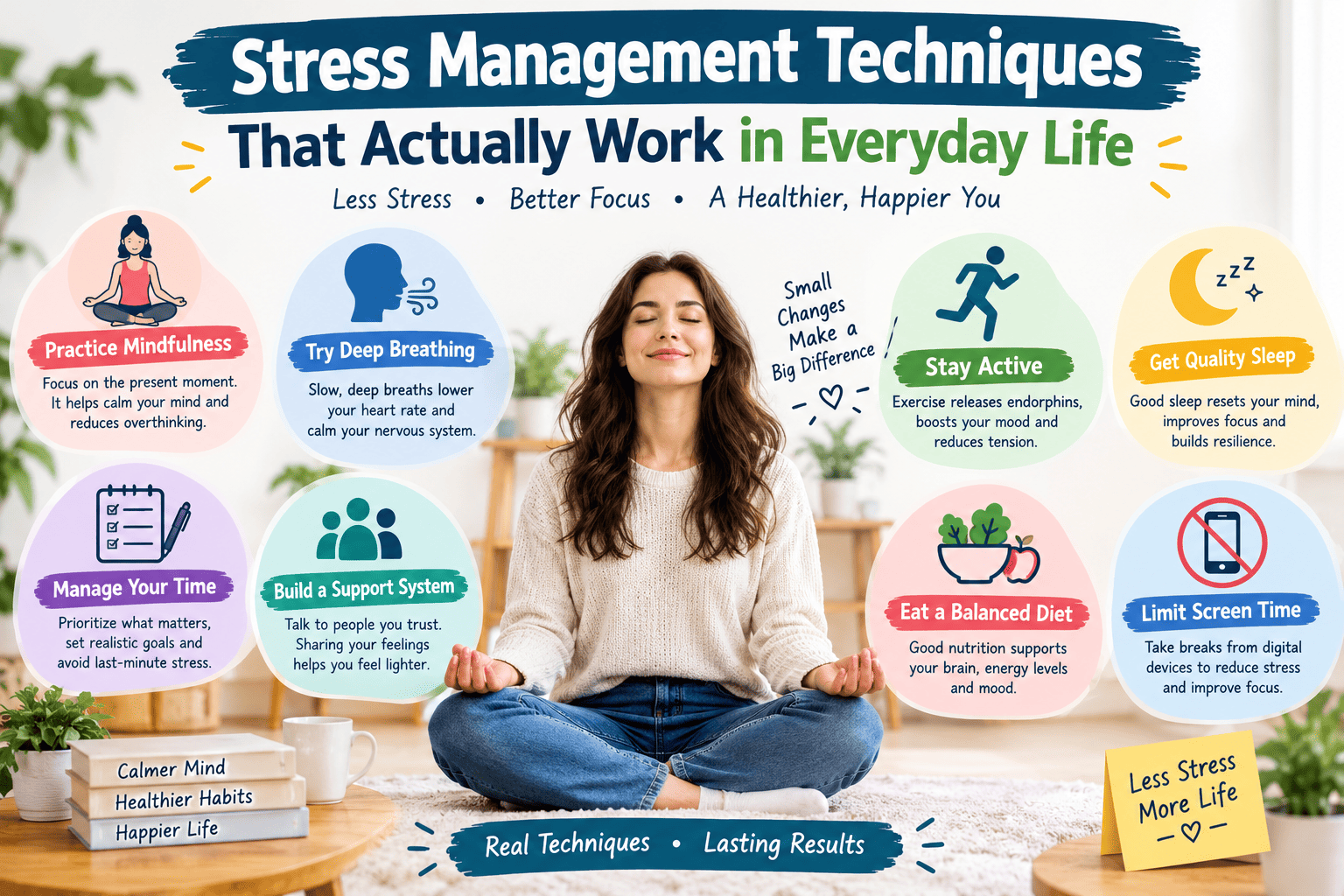
The most effective stress management techniques include slow breathing, regular physical activity, consistent sleep, mindfulness, realistic time management, and talking with supportive people. These habits can help you respond to pressure more calmly and improve your daily well-being. Start with one or two manageable changes, practice them consistently, and seek professional support if stress becomes overwhelming or interferes with everyday life.
Introduction
Stress is a normal part of life. It can appear when deadlines pile up, financial worries grow, family responsibilities become demanding, or unexpected problems disrupt your plans. A little stress can sometimes motivate you to take action, but persistent stress can affect your mood, concentration, sleep, relationships, and physical well-being.
The good news is that managing stress does not always require major lifestyle changes. Small, repeatable actions can help you feel more prepared to handle difficult situations. The key is finding techniques that fit your circumstances and practicing them before stress becomes overwhelming.
The World Health Organization’s guide, Doing What Matters in Times of Stress, recommends practical coping skills such as grounding, noticing difficult thoughts, acting on personal values, and treating yourself with kindness. These approaches can be practiced in just a few minutes a day.
In this guide, you will learn which stress management techniques are worth trying, how to use them in everyday situations, and when it may be time to seek additional help.
What Is Stress Management?
Stress management is the process of recognizing stress, understanding its causes, and using healthy strategies to respond to it. The goal is not to eliminate every stressful experience. Instead, it is to improve your ability to handle challenges without allowing stress to control your decisions, habits, or relationships.
Stress management generally involves three areas:
- Reducing avoidable stress: Addressing problems, setting boundaries, and organizing responsibilities.
- Improving your response: Practicing relaxation, mindfulness, and healthier thinking patterns.
- Building resilience: Supporting your physical health, maintaining relationships, and developing practical coping skills.
Different techniques work for different people. Someone experiencing work pressure may benefit from setting priorities, while someone dealing with racing thoughts may find slow breathing or grounding more useful.
10 Stress Management Techniques That Actually Work
1. Practice Slow, Controlled Breathing
When you feel stressed, your breathing may become faster or shallower, and your muscles may tighten. Slowing your breathing can help you pause and settle your body’s stress response.
You do not need special equipment or a quiet room to practice this technique.
How to practice:
- Sit comfortably and relax your shoulders.
- Breathe gently through your nose for about four seconds.
- Exhale slowly for about six seconds, if comfortable.
- Continue for one to two minutes without forcing your breath.
- Return to normal breathing if you feel dizzy or uncomfortable.
Adjust the timing to suit your comfort. The aim is gentle, steady breathing rather than taking unusually deep breaths.
When it helps: Try this before an important meeting, during a difficult conversation, or when you notice tension building.
Slow breathing may help reduce immediate feelings of tension, but it is not a complete solution to ongoing problems. Pair it with practical action when the source of stress can be addressed.
2. Move Your Body Regularly
Physical activity is one of the most useful habits for supporting both physical and mental well-being. Movement can provide a break from repetitive worries, improve mood, and support sleep.
You do not have to begin with an intense workout. A short walk, gentle stretching, cycling, dancing, or another activity you enjoy can be a realistic starting point.
Ways to add movement to your day:
- Take a 10-minute walk during a break.
- Stretch after sitting for a long time.
- Walk while talking to a friend on the phone.
- Try a beginner-friendly exercise routine.
- Break up long periods of sitting with brief movement breaks.
Choose an activity that suits your fitness level and physical abilities. If you cannot exercise for long periods, smaller amounts of movement still provide a practical way to get started.
Why it matters: Regular activity can support mood and sleep, both of which influence how well you cope with stress.
3. Improve Your Sleep Routine
Stress and sleep often affect each other. Worrying can make it difficult to fall asleep, while insufficient sleep can leave you feeling less patient, focused, and emotionally prepared for challenges.
A consistent sleep routine can help you create better conditions for rest.
Try these sleep habits:
- Keep your bedtime and waking time reasonably consistent.
- Create a relaxing wind-down routine before bed.
- Reduce bright screens and stimulating activities near bedtime.
- Avoid caffeine late in the day if it interferes with your sleep.
- Keep your sleeping environment comfortable, dark, and quiet where possible.
Adults generally need at least seven hours of sleep per night, although individual needs vary.
If you cannot fall asleep because of worries, write down the main concern and one possible next step. This may help you postpone problem-solving until a more appropriate time.
Avoid treating sleep as another task you must perform perfectly. Focus on creating supportive habits instead.
4. Use Mindfulness to Return to the Present
Mindfulness involves paying attention to the present moment with curiosity rather than immediately judging every thought or feeling.
When stress builds, your attention may become trapped in thoughts about past mistakes or future problems. Mindfulness can help you notice those thoughts and redirect your attention toward what you are doing now.
A simple grounding exercise:
- Notice five things you can see.
- Identify four things you can physically feel.
- Listen for three sounds.
- Notice two smells, if present.
- Identify one taste or focus on the sensation of breathing.
You can adapt this exercise to your surroundings and comfort.
Another option is to focus on an ordinary activity, such as washing dishes, walking, or drinking water. Notice the sensations and movements instead of automatically replaying stressful thoughts.
The WHO recommends grounding and related coping skills in its stress management guidance. These exercises are skills to practice, not a requirement to make every uncomfortable feeling disappear.
5. Organize Your Time and Priorities
A crowded schedule can make even manageable responsibilities feel overwhelming. When everything seems urgent, it becomes difficult to decide where to begin.
Effective time management can reduce unnecessary pressure by turning a vague list of worries into specific actions.
Use this simple method:
- Write down the tasks occupying your attention.
- Identify the tasks that genuinely need attention today.
- Choose one important task to start with.
- Divide large assignments into smaller steps.
- Schedule breaks and leave some room for unexpected demands.
For example, instead of writing “finish the entire project,” write “outline the first section” or “complete the first three slides.”
Smaller tasks make progress easier to see and can reduce the sense that a problem is impossible to manage.
It is also important to recognize your limits. If your workload consistently exceeds the time and resources available, organization alone may not solve the problem. Discussing deadlines, sharing responsibilities, or asking for help may be necessary.
6. Talk to Someone You Trust
Stress can feel heavier when you try to manage everything alone. Speaking with a trusted friend, family member, colleague, or counselor can help you feel supported and see a situation from another perspective.
You do not always need someone to solve the problem. Sometimes, explaining what is happening is valuable in itself.
You might say:
“I’m feeling overwhelmed by everything I need to do this week. Could you listen for a few minutes while I work through it?”
If you need practical assistance, be specific about what would help. For example, ask someone to help with a task, review a plan, or simply check in with you later.
Healthy social connections can support emotional well-being, but choose people who respect your privacy and boundaries. If your usual support network is unavailable or unsafe, consider another trusted person or a qualified professional.
7. Identify and Challenge Unhelpful Thoughts
Stress does not come only from what happens. The meaning you assign to an event can also influence how you feel and respond.
For example, receiving critical feedback may lead to the thought, “I’m terrible at my job.” That conclusion may increase anxiety without helping you address the feedback itself.
A more balanced response might be, “This feedback identifies something I can improve, but it does not define my entire ability.”
You can practice this approach with three questions:
- What am I telling myself? Identify the thought behind the stress.
- What facts support or challenge it? Separate evidence from assumptions.
- What is a more balanced perspective? Choose a realistic statement that helps you act constructively.
The purpose is not to force positive thinking or deny genuine problems. It is to avoid treating every fear or prediction as an established fact.
If a situation is genuinely difficult, acknowledge that reality and focus on the next helpful step.
8. Set Healthy Boundaries
Constantly agreeing to requests, responding to messages at all hours, or taking responsibility for other people’s problems can contribute to stress.
Boundaries help you protect your time, energy, and personal needs while maintaining respectful relationships.
Examples include:
- Turning off nonessential notifications during focused work.
- Explaining when you are unavailable.
- Declining additional commitments when your schedule is full.
- Keeping work-related activities within reasonable hours when possible.
- Asking others to share responsibilities more fairly.
You can communicate boundaries without being confrontational.
For example: “I want to help, but I cannot take on another task today. I can look at it tomorrow.”
Some boundaries are difficult to establish because of financial needs, workplace expectations, family duties, or unequal power relationships. Start with changes that are realistic and safe in your circumstances.
9. Reduce Information Overload
News updates, social media notifications, online arguments, and constant phone use can keep your attention focused on problems even when you need rest.
Technology can be useful, but continuous exposure to stressful information may make it harder to relax or concentrate.
Consider trying these changes:
- Turn off notifications that are not essential.
- Check the news at planned times instead of repeatedly.
- Avoid stressful online content before bed.
- Take short breaks from social media.
- Replace some screen time with a walk, reading, or conversation.
You do not need to disconnect completely. The aim is to make your technology use more intentional.
If you notice that certain accounts or discussions repeatedly leave you anxious, consider muting them or setting limits on how often you engage.
10. Make Time for Enjoyable and Meaningful Activities
When responsibilities increase, enjoyable activities are often the first things people remove from their schedules. Unfortunately, a life consisting entirely of work and obligations can leave little opportunity to recover emotionally.
Set aside time for activities that help you feel connected, interested, relaxed, or purposeful.
These may include:
- Listening to music.
- Spending time outdoors.
- Cooking a favorite meal.
- Practicing a hobby.
- Connecting with family or friends.
- Reading or learning something new.
- Participating in a spiritual or community practice that matters to you.
You do not need to earn rest by completing every task. Recovery is part of maintaining a sustainable routine.
The WHO’s stress management guide also emphasizes acting according to personal values and treating yourself with kindness. Meaningful actions do not need to be large; a small action that reflects what matters to you can be worthwhile.
How to Manage Stress at Work or School
Workplace and academic stress often involve deadlines, competing priorities, performance expectations, and uncertainty. The best approach usually combines personal coping strategies with practical changes to the situation.
Try these steps:
Start with the next action. Identify the smallest useful step instead of focusing on the entire workload.
Clarify expectations. If instructions or deadlines are unclear, ask for clarification before spending time on the wrong task.
Take short breaks. Brief pauses can help you reset your attention during demanding periods.
Limit multitasking. Complete one focused piece of work before switching to another task whenever possible.
Communicate early. If a deadline is unrealistic, explain the situation and discuss priorities before the problem becomes urgent.
Protect recovery time. Make room for meals, movement, sleep, and activities outside work or school.
If stress is caused by bullying, harassment, unsafe conditions, or unreasonable demands, relaxation techniques are not a substitute for addressing the underlying issue. Seek appropriate support and use available reporting or assistance channels when safe to do so.
A Simple Daily Stress Management Routine
You do not need to practice all ten techniques every day. A small routine is often easier to maintain than a complicated plan.
| Time of day | Helpful action | Suggested duration |
| Morning | Breathe slowly and identify your top priorities | 3–5 minutes |
| During work or study | Take a movement or screen break | 5–10 minutes |
| Afternoon | Walk, stretch, or speak with someone supportive | 10–20 minutes |
| Evening | Write down worries and identify one next step | 5 minutes |
| Before bed | Follow a quiet, consistent wind-down routine | 15–30 minutes |
These times are examples, not medical requirements. Adapt the routine to your responsibilities, health, and available time.
Consistency matters more than making every day perfect. If you miss a practice, simply return to it when you can.
Common Stress Management Mistakes to Avoid
Some habits may provide temporary distraction without helping you address stress over time.
Ignoring the source of stress: Relaxation can help you cope, but an ongoing problem may also require a practical solution.
Expecting instant results: Some techniques may help you feel calmer quickly, while other habits take repeated practice.
Trying to change everything at once: Too many new commitments can become another source of pressure. Start small.
Using unhealthy coping habits: Excessive alcohol use, smoking, recreational drugs, or other harmful behaviors can create additional problems rather than resolving the underlying stress.
Blaming yourself for feeling stressed: Stress is a normal human response. Experiencing it does not mean you are weak or failing.
Treating self-care as a substitute for support: Persistent or severe stress may require changes in your environment, practical assistance, counseling, or medical care.
A more sustainable approach is to identify what you can influence, accept that some uncertainty is unavoidable, and seek help with challenges that exceed your current resources.
When Should You Seek Professional Help for Stress?
Everyday stress can often be managed with healthy habits and support, but self-help is not always enough.
Consider speaking with a qualified mental health professional or healthcare provider if stress:
- Persists or becomes increasingly difficult to manage.
- Regularly interferes with sleep, work, education, or relationships.
- Causes frequent panic, intense anxiety, or ongoing low mood.
- Leads to increasing reliance on alcohol or other substances.
- Makes ordinary responsibilities feel impossible.
- Does not improve despite reasonable attempts to address it.
A professional can help you understand what may be contributing to your distress and discuss suitable treatment or support options.
If you feel unable to keep yourself safe or are experiencing an immediate mental health crisis, contact local emergency services or seek urgent help from a healthcare facility.
Seeking support is a practical step toward well-being, not a sign of weakness.
Frequently Asked Questions About Stress Management
What is the fastest way to manage stress?
For immediate stress, try pausing, relaxing your shoulders, and breathing slowly and comfortably for one or two minutes. Grounding yourself by noticing your surroundings may also help. If the stress comes from a practical problem, identify one manageable action you can take next.
What are the five main stress management techniques?
Five useful approaches are controlled breathing, regular physical activity, adequate sleep, mindfulness or grounding, and social support. Time management and healthy boundaries can also be important, depending on the source of stress.
Can stress be managed naturally?
Many people can improve their ability to cope with stress through movement, sleep habits, relaxation, supportive relationships, and practical problem-solving. However, persistent or severe symptoms may require professional assessment and treatment.
How can I reduce stress at home?
Create a realistic daily routine, share household responsibilities where possible, take short breaks, maintain supportive relationships, and make time for enjoyable activities. If family conflict is a major source of stress, consider safe boundaries or appropriate outside support.
Does exercise help with stress management?
Regular physical activity can support mood, sleep, and overall well-being. Walking, stretching, cycling, dancing, and other activities suited to your abilities are possible starting points. Choose something sustainable rather than forcing yourself into an intense routine.
How long does it take for stress management techniques to work?
The experience varies. Slow breathing or grounding may help some people feel calmer within minutes, while improvements associated with regular activity, sleep routines, and other habits may take longer. The results depend on the person, the stressor, and how consistently the techniques are practiced.
What should I do if stress keeps coming back?
Look for recurring triggers and consider whether they can be reduced or addressed directly. Keep using helpful coping techniques, seek support from trusted people, and consider professional guidance if stress continues to interfere with your life.
Conclusion
Stress management is not about controlling every event or never feeling overwhelmed. It is about developing practical ways to respond to challenges while protecting your health, relationships, and daily functioning.
Start with a few manageable techniques: practice slow breathing, move your body regularly, improve your sleep routine, organize your priorities, and connect with supportive people. Add other strategies as you discover what works best for your situation.
Most importantly, remember that managing stress is a skill that develops through practice. Small, consistent actions can help you build healthier routines and respond to everyday challenges with greater flexibility.
The best stress management technique is one you can use realistically, adapt to your needs, and combine with appropriate support when life becomes difficult.
 Blessingtide.com usa