

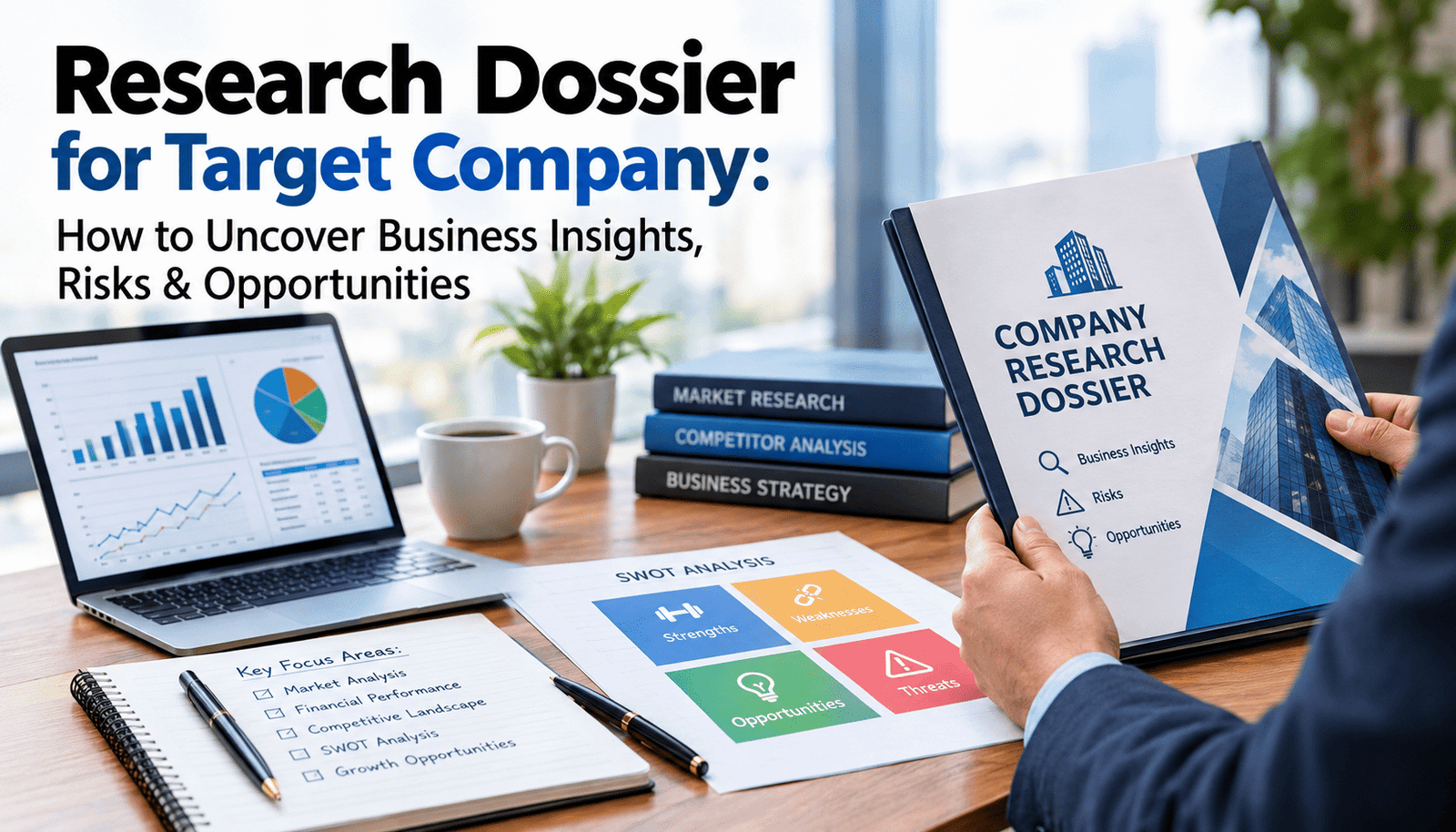
A research dossier for a target company is a structured collection of verified information about a business, including its background, leadership, products, financial performance, market position, competitors, potential risks, and growth opportunities. It helps investors, business owners, sales professionals, analysts, and decision-makers understand a company before making important business decisions. A well-prepared dossier combines reliable public records, company disclosures, market research, and independent analysis to create a clear picture of the target company’s strengths, weaknesses, and future prospects.
Introduction
Making an important business decision without understanding the company involved can create unnecessary uncertainty. Whether an organization is considering a potential acquisition, evaluating a new supplier, researching a competitor, or identifying a promising sales prospect, accurate company information plays a central role in the decision-making process. This is where a research dossier for a target company becomes valuable.
A research dossier is more than a basic company profile. It brings together relevant business information from multiple sources and organizes it into a practical document that explains what a company does, how it operates, where it stands in its industry, and what challenges or opportunities may influence its future. Instead of relying on scattered website information or unverified claims, decision-makers can use a structured dossier to evaluate the business from several perspectives.
The real value of this research lies in its ability to turn information into insight. A company may appear successful because of its brand recognition, impressive website, or expanding product range, but a deeper investigation might reveal competitive pressure, operational weaknesses, regulatory exposure, or opportunities that have not yet been fully developed.
This guide explains how to prepare a comprehensive target company research dossier, which information to collect, how to evaluate reliable sources, and how to transform findings into useful business intelligence.
What Is a Research Dossier for a Target Company?
A research dossier for a target company is a structured business research document that consolidates relevant information about a specific organization. It provides an organized overview of the company’s identity, operations, ownership, market position, financial condition, competitive environment, and potential risks.
The term target company can refer to different types of organizations depending on the purpose of the research. For an investor, it may be a business being considered for investment. For an acquisition team, it could be a potential merger or purchase candidate. For a sales department, the target might be a prospective customer. For a procurement team, it may be a supplier under evaluation.
Although the research objectives differ, the underlying principle remains the same: collect credible evidence, assess its significance, and present the results in a format that supports informed decisions.
A strong dossier generally includes the company’s legal and trading names, headquarters, industry, ownership structure, leadership team, products or services, financial information where available, customers and competitors where verifiable, and important developments affecting the business.
It should also explain the limitations of the available information. For example, privately held companies may not publish detailed financial statements, while newly established businesses may have limited operating histories. A professional dossier distinguishes confirmed facts from estimates, interpretations, and information that remains unavailable.
Why Is a Target Company Research Dossier Important?
Business research becomes particularly valuable when a decision involves financial commitments, contractual obligations, reputational concerns, or long-term strategic planning. A well-organized dossier helps decision-makers examine these factors before committing resources.
Better Business Decision-Making
A structured research document gives decision-makers a clearer understanding of the company under consideration. Rather than relying on assumptions, they can compare documented facts, identify unresolved questions, and evaluate whether a potential opportunity aligns with their objectives.
For example, a business considering a new distribution partner can investigate the partner’s operating history, service coverage, reputation, and ability to meet contractual requirements. This information can help the business decide whether to proceed, request additional documentation, or consider alternative partners.
Early Identification of Business Risks
Every organization faces some degree of financial, operational, legal, competitive, and reputational risk. A research dossier can help identify warning signs before they become expensive problems.
These signs may include unresolved regulatory issues, inconsistent corporate information, excessive dependence on a single customer, significant leadership turnover, or repeated service complaints supported by credible evidence. Such findings do not automatically prove that a company is unsuitable, but they indicate areas requiring further investigation.
Stronger Competitive Intelligence
Businesses need to understand how their competitors position themselves, attract customers, price their offerings, and respond to changes in the market. A target company dossier can organize this information into a useful competitive assessment.
The objective is not simply to collect competitor names. It is to understand what differentiates the company, which customer needs it serves, and where competing businesses may have an advantage.
More Effective Investment and Partnership Evaluation
Investors, lenders, and potential business partners need evidence that supports their assessment of a company’s commercial prospects. A research dossier can provide an initial view of the organization’s business model, market position, financial indicators, and potential challenges.
However, an initial research dossier should not replace formal financial due diligence, legal review, or professional advice when a transaction carries significant financial or legal consequences.
Key Components of a Comprehensive Company Research Dossier
The strength of a dossier depends on the relevance, reliability, and organization of its contents. Each section should answer a specific business question rather than simply add more information to the document.
1. Company Overview and Background
Begin with a concise overview of the target company. This section establishes its identity and gives readers the context needed to understand the remaining analysis.
Include the company’s legal name, trading name, year of establishment, headquarters, industry, business model, primary products or services, and main operating markets when these details can be verified.
It is also useful to examine the company’s development over time. Important milestones might include the launch of a major product, expansion into another market, a merger, a change in ownership, or the opening of a new facility.
Use the company’s official website and published corporate materials as starting points, then compare important claims with independent sources and relevant official records.
2. Ownership Structure and Leadership
Understanding who owns and manages a company can help explain its strategic direction, governance arrangements, and decision-making structure.
Research the founders, executives, board members, parent company, subsidiaries, and publicly disclosed ownership information where applicable. For a publicly traded company, regulatory filings may provide details about significant shareholders and executive responsibilities. Private companies may disclose considerably less information.
Leadership research should focus on professional experience, documented responsibilities, relevant achievements, and significant management changes. Avoid drawing conclusions about an individual’s credibility or character from unverified online claims.
If ownership information is incomplete, state that limitation clearly. Do not confuse a company’s directors with its shareholders, beneficial owners, or ultimate parent organization, because these roles are not necessarily the same.
3. Products, Services, and Business Model
A useful research dossier explains how the company creates value and generates revenue.
Identify its main products and services, intended customers, pricing approach where publicly available, distribution channels, and major sources of income. Determine whether the business operates through direct sales, subscriptions, licensing, retail, manufacturing, professional services, or another model.
Next, assess the company’s value proposition. Does it compete on price, product quality, specialist expertise, customer service, convenience, technology, or brand reputation?
This analysis should distinguish what the company claims about its offering from what independent evidence supports. Product documentation, customer case studies, credible reviews, and publicly available performance information may help establish a more balanced view.
4. Financial Performance and Business Stability
Financial research is an important part of a dossier when relevant information is available. It helps decision-makers evaluate a company’s commercial performance, financial resilience, and ability to support future commitments.
For public companies, useful sources may include annual reports, quarterly statements, audited financial statements, investor presentations, and applicable regulatory filings. Depending on the business, analysts may examine revenue trends, operating profit, net income, cash flow, debt, liquidity, and capital expenditure.
Private companies require a different approach. Their financial information may be limited, so analysts might need authorized financial statements, credit reports, payment references, or documentation supplied directly by the company.
Financial indicators should be interpreted in context. Revenue growth does not automatically mean profitability, and a high level of debt does not independently establish that a company is in financial distress. Industry conditions, accounting policies, business maturity, and cash-flow requirements can significantly affect the interpretation.
If figures are estimates rather than verified disclosures, label them accordingly and explain the methodology and date.
5. Industry and Market Analysis
A company cannot be evaluated properly without understanding the market in which it operates. Industry research explains the external conditions that may influence its performance.
Examine market size, customer demand, purchasing behavior, major trends, technological developments, regulatory changes, and barriers to entry. Consider whether the market is expanding, stable, or facing structural challenges.
For example, a technology company may benefit from increasing demand for automation but face pressure from rapidly changing technology and strong competition. A manufacturing business may have reliable demand but remain exposed to raw-material costs, energy prices, and supply-chain disruptions.
Industry reports, government statistics, trade associations, reputable business publications, and research institutions can help establish the broader context.
The goal is to connect market conditions with the target company’s actual business model rather than assuming that every company benefits equally from a positive industry trend.
6. Competitor Analysis and Market Position
Competitor analysis identifies the businesses competing for the same customers, contracts, resources, or market share.
Start by identifying direct competitors offering similar products to the same customer groups. Then consider indirect competitors that address the same customer needs through different solutions.
Compare relevant factors such as product range, pricing, geographic reach, distribution networks, customer segments, innovation, service quality, and brand positioning. Market-share comparisons should only be included when credible and comparable data are available.
A simple comparison table can help organize the findings.
| Research factor | What to investigate |
| Products and services | Main offerings and differentiating features |
| Target customers | Customer segments and industries served |
| Pricing | Publicly available prices and pricing models |
| Market reach | Countries, regions, and distribution channels |
| Competitive advantage | Documented strengths and capabilities |
| Market challenges | Barriers, substitutes, and competitive pressure |
This comparison can reveal where the target company performs well, where its competitors appear stronger, and which market segments may offer room for expansion.
7. Customer Reputation and Brand Perception
Customer feedback can provide useful insight into service quality, product reliability, customer support, and brand reputation. However, online reviews should be assessed carefully because they may not represent the company’s entire customer base.
Look for recurring themes across multiple independent sources rather than treating a single positive or negative review as definitive evidence. Consider the dates of reviews, the number of responses, the nature of complaints, and whether the company has addressed recurring concerns.
For business-to-business organizations, publicly disclosed client relationships, documented case studies, testimonials, contract announcements, and industry references may provide additional context.
It is equally important to distinguish verified customers from organizations merely mentioned in marketing materials. If a customer relationship cannot be independently confirmed, describe it as a company-reported claim rather than an established fact.
8. Legal, Regulatory, and Compliance Review
Legal and regulatory research is particularly important when evaluating suppliers, acquisition candidates, investment opportunities, and business partners.
Depending on the jurisdiction and industry, relevant checks may include company registration, corporate status, licensing, regulatory enforcement, material litigation, insolvency records, sanctions screening, and relevant compliance disclosures.
Use official government registries, court databases, regulators, and other authoritative records whenever possible. Search results, news reports, and third-party databases can provide leads, but important findings should be confirmed against primary documentation where available.
A legal dispute does not automatically establish wrongdoing, and an allegation should not be presented as a proven violation. Record the nature of the matter, the relevant date, the status of the proceedings, and the source.
For significant transactions, involve qualified legal and compliance professionals. The scope of the review should reflect the applicable laws, industry requirements, transaction size, and geographic exposure.
How to Identify Business Risks in a Target Company
Risk analysis is one of the most valuable parts of a research dossier because it helps readers understand what could affect a company’s operations, financial position, or future prospects.
Instead of creating a general list of possible problems, connect each identified risk to specific evidence and a realistic business consequence.
Financial Risks
Financial risks may involve declining revenue, weak cash generation, significant debt obligations, customer concentration, or dependence on external financing.
Investigate financial trends over several reporting periods where possible. A single weak quarter may reflect seasonal demand, while a sustained pattern of declining performance may require deeper analysis.
For private companies, ask for appropriate documentation through authorized channels rather than relying on unsupported online estimates.
Operational Risks
Operational risks arise from the way a company delivers its products and services. These may include supplier dependence, production interruptions, outdated systems, workforce shortages, quality-control problems, or inadequate business continuity arrangements.
Examine the company’s facilities, supply-chain structure, service commitments, and publicly disclosed operational challenges. Determine whether a problem is an isolated event or part of a recurring pattern.
Market and Competitive Risks
Changes in customer preferences, new competitors, technological disruption, or pricing pressure can weaken a company’s market position.
Research whether its core products remain relevant and whether its competitive advantages are sustainable. A business that depends heavily on a single product or market may face greater exposure if demand changes.
Legal and Reputational Risks
Regulatory investigations, documented compliance failures, material litigation, and repeated substantiated customer complaints may affect a company’s reputation or ability to operate.
Every finding needs context. Verify the relevant parties, dates, jurisdiction, and status of the matter before drawing conclusions. Avoid treating anonymous accusations or isolated online comments as established evidence.
Cybersecurity and Data Risks
For companies that handle customer data, financial information, digital infrastructure, or sensitive business records, cybersecurity deserves particular attention.
Relevant evidence may include public incident disclosures, regulatory notices, published security certifications, privacy policies, and documented business continuity measures. The absence of a publicly reported incident does not prove that a company has no cybersecurity weaknesses.
A useful dossier records each risk, its supporting evidence, its potential impact, and any unanswered questions requiring follow-up.
How to Uncover Growth Opportunities
A comprehensive company research dossier should examine positive possibilities as carefully as it examines risks. The objective is to identify realistic ways a business might strengthen its position, expand its operations, or improve its performance.
Market Expansion
Research whether the company has opportunities to enter new geographic markets, serve additional customer segments, or increase distribution coverage.
Consider local demand, regulatory requirements, competition, logistics, and the cost of expansion. A growing market may appear attractive, but entering it successfully can require substantial investment and local expertise.
Product and Service Development
Customer feedback, industry developments, and competitor offerings can reveal unmet needs that a company may be able to address.
Look for evidence of demand, product-development capabilities, and the company’s ability to deliver improvements. Avoid assuming that a new product will succeed simply because it addresses a popular trend.
Strategic Partnerships
Partnerships may help companies gain access to new customers, technologies, distribution networks, or specialist capabilities.
Review existing partnership announcements and identify potential areas of strategic alignment. Any proposed opportunity should be evaluated for commercial feasibility, compatibility, costs, and execution risks.
Technology and Operational Improvement
Automation, digital tools, process redesign, and better data management may improve efficiency or customer experience in suitable businesses.
Research existing technology investments, operating processes, and documented performance challenges. Recommendations should be based on identifiable needs rather than generic assumptions that every company requires the same technology.
Customer and Revenue Diversification
A company that relies heavily on one customer, product, supplier, or geographic market may have an opportunity to reduce concentration by expanding its customer base or revenue sources.
Before recommending diversification, examine the financial and operational resources required. Growth is most valuable when it can be achieved sustainably without introducing disproportionate complexity or risk.
Step-by-Step Process for Creating a Research Dossier
A repeatable research process improves consistency, reduces unnecessary work, and makes findings easier to verify.
Step 1: Define the Research Objective
Start by establishing why the target company is being researched. An acquisition dossier requires a different level of detail from a sales prospecting profile or a supplier assessment.
Define the key decision the research must support, the information needed, the relevant jurisdiction, and any deadlines. Clear objectives prevent the project from becoming a collection of unrelated facts.
Step 2: Establish the Company’s Identity
Confirm the company’s legal name, trading names, official website, registration details where available, and relevant business locations.
This step is essential when multiple companies have similar names. Check that the sources refer to the same legal entity rather than a subsidiary, unrelated organization, or similarly named business.
Step 3: Collect Information from Reliable Sources
Build a source list before beginning detailed analysis. Prioritize official filings, regulatory records, company disclosures, audited reports, government statistics, and reputable industry research.
Use news coverage and specialist publications to identify developments that may require further verification. Record the source URL, publication date, relevant reporting period, and date accessed.
Step 4: Organize the Evidence
Group findings into logical sections, such as company background, ownership, operations, financial performance, market position, legal matters, risks, and opportunities.
A spreadsheet or research database can help track each claim, its source, its verification status, and the questions that remain unresolved.
Step 5: Verify Important Claims
Cross-check significant information against independent sources whenever practical. Compare company-reported details with public records and ensure that financial figures refer to compatible periods.
If two reliable sources disagree, document the discrepancy instead of choosing one without explanation. The conflict itself may be important to the final assessment.
Step 6: Analyze the Findings
Move beyond description by explaining why each important fact matters. For instance, a newly announced distribution agreement may indicate potential market expansion, but its commercial significance depends on the agreement’s scope, timing, and expected contribution.
Separate objective findings from analytical judgments. This distinction allows readers to understand which conclusions are supported directly by evidence and which involve interpretation.
Step 7: Assess and Prioritize Risks
Evaluate identified risks according to their likelihood, potential impact, and relevance to the intended decision.
A useful starting framework is a qualitative matrix.
| Risk level | General interpretation | Suggested response |
| Low | Limited expected impact | Monitor as appropriate |
| Medium | Meaningful uncertainty or exposure | Investigate and consider mitigation |
| High | Potentially significant consequences | Escalate for detailed review |
| Critical | Could threaten the proposed decision or essential requirements | Pause the decision pending appropriate resolution |
These labels are not universal standards. Define the criteria used for each rating and avoid presenting subjective assessments as precise statistical predictions.
Step 8: Prepare the Executive Summary
The executive summary should present the most important conclusions in a concise, decision-focused format.
Explain what the company does, its most relevant strengths, the principal risks, the strongest potential opportunities, the quality of the available evidence, and the next steps recommended.
Readers should be able to understand the central findings without having to review every page of the dossier.
Best Sources for Target Company Research
The quality of a research dossier depends heavily on its sources. Different types of information require different verification methods.
| Source type | Information it may provide |
| Official company website | Products, services, leadership announcements, locations |
| Government business registry | Legal identity, registration status, filed documents where available |
| Annual reports and regulatory filings | Financial performance, governance, material disclosures |
| Industry publications | Market trends, competitor developments, sector analysis |
| Government statistics | Economic indicators, industry data, trade information |
| Court and regulatory records | Documented legal proceedings and enforcement actions |
| Reputable news organizations | Major transactions, leadership changes, company developments |
| Customer reviews and case studies | Reported customer experiences and service-related themes |
| Company-issued presentations | Strategic priorities, reported performance, growth plans |
No single source can establish every aspect of a company’s position. The best approach combines primary records with credible independent evidence and acknowledges where information is unavailable.
Analysts should also respect privacy, applicable data-protection requirements, website terms, and relevant laws. A business research dossier should rely on legitimate information sources and authorized access rather than deceptive collection methods.
Common Mistakes to Avoid When Preparing a Company Dossier
Even a detailed dossier can produce misleading conclusions if the research process is poorly managed.
One common mistake is relying entirely on the target company’s own website. Corporate websites are useful for understanding a company’s stated position, but they are not independent proof of every claim. Important information should be cross-checked whenever possible.
Another mistake is collecting large amounts of information without connecting it to the research objective. A lengthy document is not necessarily a useful document. Each section should help answer a business question, clarify an uncertainty, or support a decision.
Outdated information is another major problem. Leadership, ownership, financial performance, and regulatory status can change. Record relevant dates and verify time-sensitive information before the dossier is finalized.
Researchers should also avoid confusing allegations with established facts, treating estimated financial figures as audited results, or assuming that a company’s absence from a particular database means it does not exist.
Finally, do not force a positive or negative conclusion when the evidence is inconclusive. A credible dossier communicates uncertainty openly and identifies what additional information would resolve it.
Research Dossier vs. Company Profile vs. Due Diligence
These three concepts overlap, but they serve different purposes.
| Feature | Company profile | Research dossier | Formal due diligence |
| Main purpose | Introduce the business | Analyze the company for a specific decision | Verify material matters before a transaction or commitment |
| Typical depth | Basic to moderate | Moderate to comprehensive | Depends on transaction and risk |
| Information sources | Often company-provided | Company and independent sources | Detailed documentary evidence and specialist reviews |
| Risk assessment | Usually limited | A core research component | Often extensive and transaction-specific |
| Financial review | May be brief | Depends on the objective and available evidence | May involve detailed financial verification |
| Legal review | Usually minimal | Identifies relevant issues | May require qualified legal analysis |
| Typical users | Customers, readers, partners | Analysts, sales teams, investors, managers | Acquirers, investors, lenders, legal and financial teams |
A company profile provides an introduction. A research dossier offers a broader analytical view. Formal due diligence goes further by verifying material information and examining specific risks in greater depth.
The appropriate level of investigation depends on the decision. A preliminary sales assessment may require only a focused dossier, while a major acquisition may require extensive financial, legal, tax, operational, and commercial due diligence.
How to Present a Research Dossier Professionally
A dossier should be easy to navigate, understand, and update. Clear presentation improves the usefulness of the research, particularly when the document will be shared with executives, clients, investors, or other decision-makers.
Begin with a title page containing the target company’s name, the research purpose, the preparation date, and the document’s version. Include an executive summary before the detailed sections so readers can quickly identify the central findings.
Use consistent headings, concise paragraphs, relevant tables, and charts only when they improve understanding. For financial comparisons, state the currency, reporting period, and source. For market data, identify the geographic scope and date range.
A source register should record where important information originated. Consider adding a verification status to key claims, such as confirmed, company-reported, independently reported, estimated, or unresolved.
The final section should list the main risks, potential opportunities, open questions, and recommended follow-up actions. If the dossier will be used repeatedly, establish a review schedule and update it when material company developments occur.
Conclusion
A research dossier for a target company provides a practical foundation for understanding an organization before making an important business decision. By combining company background, ownership details, financial indicators, market research, competitor analysis, regulatory information, and risk assessment, it creates a more complete view of the business than a basic company profile can offer.
The most effective dossiers prioritize evidence over assumptions. They distinguish verified information from company claims, explain the significance of important findings, and acknowledge gaps that require additional investigation.
Whether the objective is to evaluate an investment, select a supplier, assess a competitor, explore an acquisition, or identify a prospective customer, a structured research process can improve clarity and reduce avoidable uncertainty.
Ultimately, the purpose of a dossier is not simply to collect facts. It is to transform reliable information into actionable business intelligence that helps decision-makers recognize risks, assess opportunities, ask better questions, and determine the next steps with greater confidence.
Frequently Asked Questions (FAQs)
1. What is a research dossier for a target company?
A research dossier is an organized document containing verified and relevant information about a company. It typically covers its background, ownership, leadership, products, financial performance, competitors, market conditions, potential risks, and growth opportunities.
2. What should be included in a target company research dossier?
A comprehensive dossier usually includes an executive summary, company overview, ownership structure, leadership information, business model, financial analysis where available, industry research, competitor comparisons, legal and regulatory findings, risk assessment, opportunities, and source references.
3. How do you research a target company effectively?
Begin by defining the research objective and confirming the company’s identity. Gather information from official records, company disclosures, regulatory filings, reputable news sources, and relevant industry research. Verify important claims, organize the evidence, assess risks, and summarize the findings according to the intended business decision.
4. What are the best sources for company research?
Useful sources include official company websites, government business registries, annual reports, regulatory filings, court records, government statistics, industry publications, and reputable news organizations. The best sources depend on the jurisdiction, the company type, and the specific information being investigated.
5. What is the difference between a research dossier and due diligence?
A research dossier provides a structured analytical overview of a target company. Due diligence is a more detailed verification process used to investigate material financial, legal, operational, commercial, or other issues before a significant transaction or commitment.
 Blessingtide.com usa