

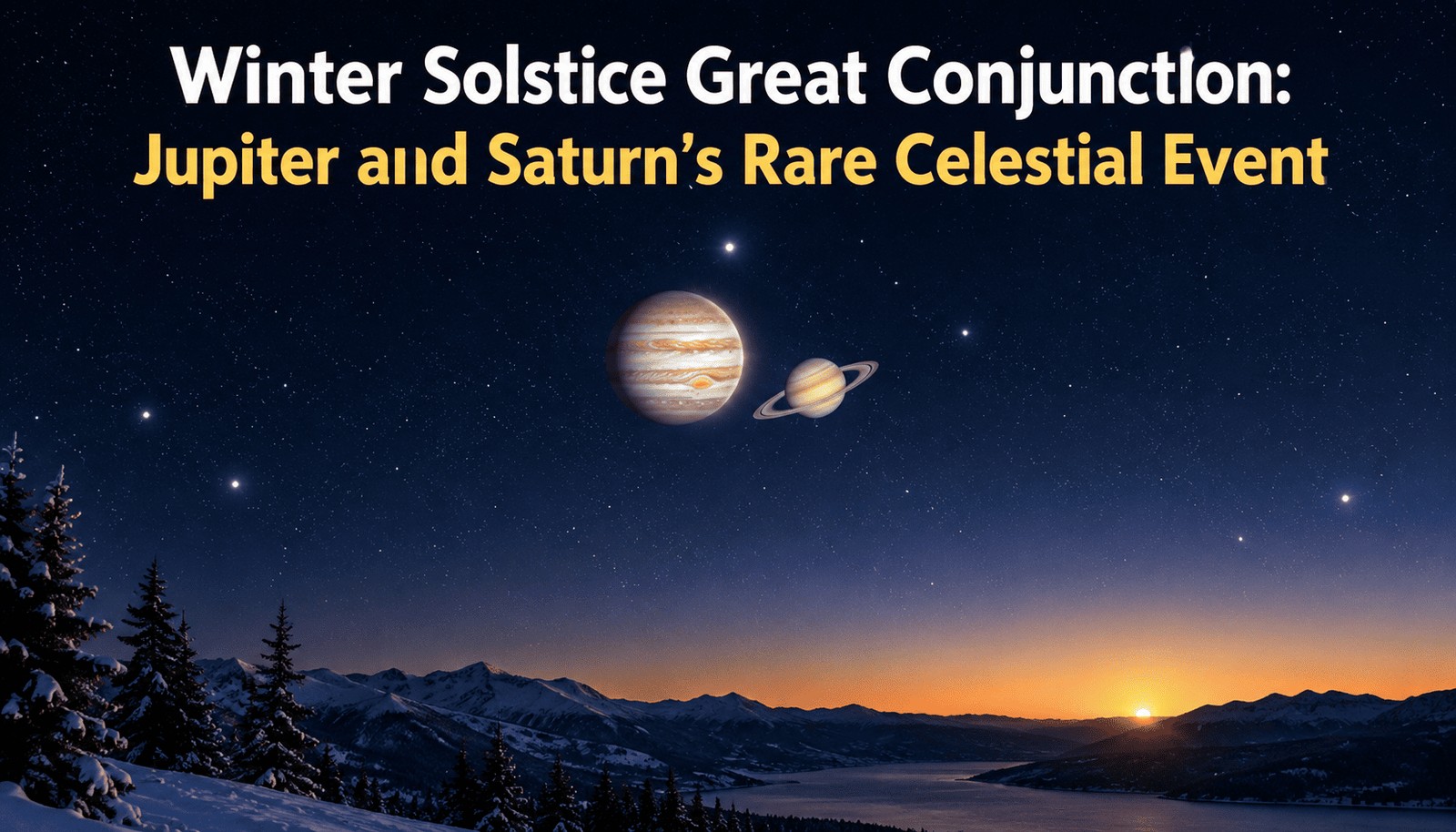
The Winter Solstice Great Conjunction occurred on December 21, 2020, when Jupiter and Saturn appeared approximately 0.1 degrees apart in Earth’s sky. This exceptionally close alignment coincided with the December solstice, creating a rare astronomical spectacle. Although the planets appeared almost side by side, they remained separated by enormous distances in space. The event was the closest apparent Jupiter-Saturn conjunction since 1623 and the closest easily observable one since 1226.
Introduction
On December 21, 2020, skywatchers witnessed an unusual astronomical event involving Jupiter and Saturn, the two largest planets in our solar system. As evening approached, the planets appeared remarkably close together, forming a bright pair in the southwestern sky after sunset. What made this occasion particularly interesting was its timing: the alignment occurred on the same date as the December solstice, when the Northern Hemisphere experiences its shortest day and longest night of the year.
Astronomers call this event a great conjunction. Although Jupiter and Saturn regularly appear near one another in the sky, their apparent separation varies considerably from one conjunction to another. In 2020, they came within approximately six arcminutes of each other, equivalent to 0.1 degrees. According to NASA and the Royal Astronomical Society, this was the closest apparent pairing since 1623. The event was especially favorable for observation because the planets were visible in the evening sky rather than being lost in the Sun’s glare.
The significance of this event goes beyond its beautiful appearance. It demonstrates how planetary orbits, Earth’s position, and viewing perspective combine to produce celestial alignments. Understanding the science behind the conjunction also helps explain why the event was unusual, why it coincided with the solstice, and when similar alignments may occur again.
What Was the Winter Solstice Great Conjunction?
The Winter Solstice Great Conjunction was the apparent close alignment of Jupiter and Saturn on December 21, 2020. In astronomy, a conjunction occurs when two celestial objects appear close together from an observer’s viewpoint. A great conjunction specifically refers to the apparent meeting of Jupiter and Saturn.
The word apparent is important. It describes how the planets look from Earth rather than their actual physical distance from one another. Jupiter and Saturn did not touch, collide, or merge. They continued traveling through their separate orbits around the Sun, while their positions made them appear unusually close when viewed from our planet.
The 2020 conjunction became a major public astronomy event because the planets were bright enough to be observed without sophisticated equipment. Under suitable conditions, people could identify both planets with the unaided eye. Binoculars and telescopes offered additional detail, making the event attractive to casual observers and experienced astronomers alike.
NASA explained that the planets appeared about one-tenth of a degree apart at their closest approach. This was a particularly small angular separation for a great conjunction and explains why some observers perceived the pair as almost a single bright object.
Research source: NASA’s explanation of the event provides the historical background and scientific details:
Why Was the 2020 Great Conjunction So Rare?
Great conjunctions happen roughly every 19.86 years on average. However, they do not always produce an equally impressive view. The apparent distance between Jupiter and Saturn depends on the geometry of their orbits and their positions relative to Earth at the time of the conjunction.
The December 2020 event was exceptional because the planets passed within approximately six arcminutes of each other. One degree contains 60 arcminutes, so six arcminutes equals 0.1 degrees. For comparison, the full Moon appears about half a degree wide in the sky. The separation between the two planets was therefore approximately one-fifth of the Moon’s apparent diameter.
The previous conjunction with a similarly close apparent separation occurred in 1623. However, that event took place near the Sun’s direction in the sky, making the planets difficult to observe. The last comparable conjunction that was readily observable under favorable conditions occurred in 1226, centuries before the invention of the modern telescope.
This distinction matters because a rare alignment is not necessarily easy to see. Astronomical calculations can establish when planets appear close together, but visibility also depends on twilight, the horizon, weather, and the Sun’s position. In 2020, the combination of exceptional closeness and evening visibility made the event particularly noteworthy.
Research source: The Royal Astronomical Society documented the six-arcminute separation and the comparison with 1623 and 1226: https://ras.ac.uk/news-and-press/news/jupiter-and-saturn-come-together-rare-great-conjunction
How Do Jupiter and Saturn Form a Great Conjunction?
Jupiter and Saturn orbit the Sun at different speeds. Jupiter completes one orbit in approximately 11.86 Earth years, while Saturn takes about 29.46 years. Because Jupiter travels around the Sun more quickly, it gradually catches up with Saturn from Earth’s perspective.
When Jupiter appears to overtake Saturn in the sky, astronomers identify the event as a great conjunction. The average interval between these alignments is approximately 19.86 years, although the precise dates and apparent separations vary.
An easy way to understand the process is to imagine two runners moving around a circular track. One runner completes each lap more quickly than the other. Eventually, the faster runner catches up and passes the slower runner. From a particular viewing position, the runners may briefly appear aligned even though they remain on different parts of the track.
The planetary version is more complicated because Jupiter, Saturn, and Earth all move through space. Their positions continuously change, so astronomers calculate their relative geometry to predict conjunction dates and viewing conditions. The resulting alignment is a natural consequence of orbital motion, not an unexplained astronomical disturbance.
Research source: Timeanddate explains the planets’ orbital periods and the approximately 20-year conjunction cycle: https://www.timeanddate.com/astronomy/planets/great-conjunction
Why Did the Conjunction Coincide With the Winter Solstice?
The December solstice occurs when Earth’s axial tilt places the Sun at its southernmost apparent position relative to the celestial equator. In the Northern Hemisphere, this produces the shortest daylight period of the year. In the Southern Hemisphere, the same date marks the summer solstice, bringing the longest daylight period.
The great conjunction and the solstice have different causes. Earth’s axial tilt determines the timing of the solstice, whereas the relative orbital positions of Jupiter, Saturn, and Earth determine the conjunction. There is no physical mechanism requiring these events to happen together.
Their coincidence on December 21, 2020, nevertheless made the occasion especially memorable. Observers could connect a seasonal turning point with a rare planetary alignment, while educators could use the event to explain two separate astronomical processes.
The date also created a cultural connection with the holiday season. Because Jupiter and Saturn appeared like a bright celestial pair shortly before Christmas, many news reports and astronomy discussions referred to them as the “Christmas Star.” That nickname describes the public association with the event rather than an official astronomical category.
What Could People See During the 2020 Alignment?
Jupiter was the brighter planet, while Saturn appeared fainter nearby. Both were visible in the evening sky after sunset, particularly when observers had an unobstructed view toward the southwest.
To the unaided eye, the planets looked like two bright points close together. Their appearance depended on local conditions, including atmospheric clarity, twilight, and the height of the planets above the horizon. In some locations, haze or buildings near the horizon made observation more difficult.
Binoculars offered a useful way to distinguish the pair more clearly. A small telescope could provide a more detailed view, potentially revealing Jupiter’s four largest moons and Saturn’s rings. Because the planets were so close together in the sky, observers with suitable equipment could see them within the same field of view.
Photographers also had an opportunity to capture the event. Wide-angle images could place the planets above a landscape or recognizable landmark, while telescopic photographs could show more planetary detail. NASA published photography guidance for people using both smartphones and dedicated cameras.
It is worth distinguishing photographs from what the eye sees directly. Long exposures and image processing can reveal faint details that are not visible to the naked eye. Nevertheless, the closeness of the two planets was observable without a camera or telescope.
Research source: NASA’s photography guide discusses practical ways to photograph the conjunction: https://science.nasa.gov/solar-system/planets/jupiter/how-to-photograph-the-conjunction-of-saturn-and-jupiter/
What Is the Difference Between a Great Conjunction and a Planetary Alignment?
A great conjunction specifically concerns Jupiter and Saturn appearing close together in the sky. A planetary alignment is a broader expression used when several planets appear arranged along a similar region of the sky.
The term alignment can sometimes be misleading. It does not necessarily mean that the planets form a perfectly straight line in three-dimensional space. Planets orbit the Sun at different distances and follow different orbital paths. They can appear aligned from Earth without occupying a single straight line through space.
Likewise, a conjunction does not mean the planets have physically moved unusually close to one another. Their angular separation as viewed from Earth becomes small, but their actual distances remain enormous.
Understanding this distinction helps prevent exaggerated claims about planetary events. A close conjunction is scientifically interesting on its own; it does not require a physical collision, an unusual gravitational effect, or a prediction about events on Earth.
When Will the Next Great Conjunction Occur?
The next Jupiter-Saturn great conjunction after the 2020 event is expected in late October or early November 2040, followed by another in April 2060. Exact dates can vary depending on the astronomical definition of conjunction being used, so updated ephemerides should be consulted when planning an observation.
These future events will not necessarily reproduce the exceptional closeness of the 2020 conjunction. Great conjunctions recur regularly, but the angular separation between Jupiter and Saturn changes from one event to another. Some pairings look more dramatic than others, and visibility depends on the time of year and the planets’ positions relative to the Sun.
A particularly close and favorable conjunction is expected on March 15, 2080, according to published conjunction tables. That event is noteworthy because the 2020 alignment’s unusually small separation is not something observers can expect at every approximately 20-year interval.
For anyone interested in future skywatching, the most useful approach is to check a reputable astronomy calendar as the event approaches. Local observing times, twilight, weather, and the planets’ altitude above the horizon will determine the best opportunity to see them.
Was the Great Conjunction the Star of Bethlehem?
The 2020 alignment was widely nicknamed the Christmas Star because it occurred shortly before Christmas and created an unusual bright pairing in the evening sky. The name also encouraged comparisons with the Star of Bethlehem described in the Christian biblical tradition.
However, the historical identity of the Star of Bethlehem remains uncertain. Various explanations have been proposed, including planetary conjunctions and other astronomical phenomena, but the 2020 event does not establish what the ancient account described.
The distinction between historical interpretation and astronomical observation is important. Scientists can calculate the positions of planets and establish when conjunctions occurred. Determining whether a particular event corresponds to an ancient religious narrative requires additional historical evidence and remains a matter of interpretation.
The Christmas Star nickname is therefore best understood as a cultural description of the 2020 conjunction, not as a scientifically established identification of the biblical star.
Why This Event Matters to Astronomy
The Winter Solstice Great Conjunction offered a clear demonstration of orbital motion and perspective. Jupiter and Saturn appeared exceptionally close because of their relative positions as seen from Earth, while their separate orbits continued unchanged.
The event also demonstrated how astronomy can make complex scientific ideas accessible. Observers could see the alignment directly, compare it with published sky charts, and use binoculars or telescopes to investigate the planets further. The conjunction connected a mathematical prediction with a visible event that people could experience for themselves.
Its historical context made it even more interesting. Comparing the 2020 conjunction with the difficult-to-observe event of 1623 and the favorable viewing conditions in 1226 shows why astronomers consider both the timing and the geometry of an event when evaluating its significance.
Ultimately, the conjunction was not extraordinary because the planets touched or changed their physical behavior. It was extraordinary because the geometry of the solar system produced an unusually close and accessible view of two giant planets at the same time as a seasonal milestone on Earth.
Conclusion
The Winter Solstice Great Conjunction of December 21, 2020, was a remarkable astronomical event in which Jupiter and Saturn appeared only about 0.1 degrees apart. Their close apparent alignment coincided with the December solstice, creating a memorable opportunity for skywatchers to observe two giant planets together.
Scientific measurements, historical comparisons, and orbital calculations explain why this event attracted so much attention. Although great conjunctions occur roughly every 20 years, the planets do not appear equally close at every meeting. The 2020 event was especially notable because it combined an exceptionally small apparent separation with favorable evening visibility.
Future conjunctions will provide new opportunities to observe the changing positions of Jupiter and Saturn. By understanding the difference between apparent alignment and physical distance, readers can appreciate these events as both beautiful sights and practical demonstrations of how our solar system works.
Frequently Asked Questions
1. What date was the Winter Solstice Great Conjunction?
It occurred on December 21, 2020, when Jupiter and Saturn reached an exceptionally close apparent alignment in Earth’s sky.
2. How close did Jupiter and Saturn appear in 2020?
Their closest apparent separation was approximately six arcminutes, equivalent to 0.1 degrees or about one-fifth of the apparent width of the full Moon.
3. Why was the 2020 conjunction considered rare?
The planets appeared closer together than during any conjunction since 1623. The 1623 event was difficult to observe because the planets appeared near the Sun’s direction in the sky.
4. Did Jupiter and Saturn physically come together?
No. The conjunction was an apparent alignment viewed from Earth. Both planets continued along their separate orbits and remained far apart in space.
5. How often do Jupiter and Saturn have a great conjunction?
They form a great conjunction approximately every 19.86 years on average. The exact timing and apparent separation vary with their orbital geometry.
6. When will the next great conjunction occur?
The next event is expected in late October or early November 2040, followed by another in April 2060. The particularly close conjunction expected in 2080 is also of interest to astronomers.
7. Was the conjunction visible without a telescope?
Yes. Jupiter and Saturn were visible to the unaided eye under suitable conditions. Binoculars and telescopes provided additional detail, including views of Jupiter’s moons and Saturn’s rings.
8. Did the winter solstice cause the conjunction?
No. The solstice results from Earth’s axial tilt, while the conjunction results from the relative orbital positions of Jupiter, Saturn, and Earth. Their shared date in 2020 was coincidental.
 Blessingtide.com usa